La Orotava, Tenerife, is worth a half-day for its carved wooden balconies, hillside gardens and historic streets. I’d choose it for architecture and a slow lunch rather than beach time. The catch is the gradient: this is a compact old town, but its cobbles and climbs make it more demanding than the map suggests.
By Mihail Schwarz. Visitor information checked on 30 September 2026.
La Orotava old town: the aristocratic heart of the valley
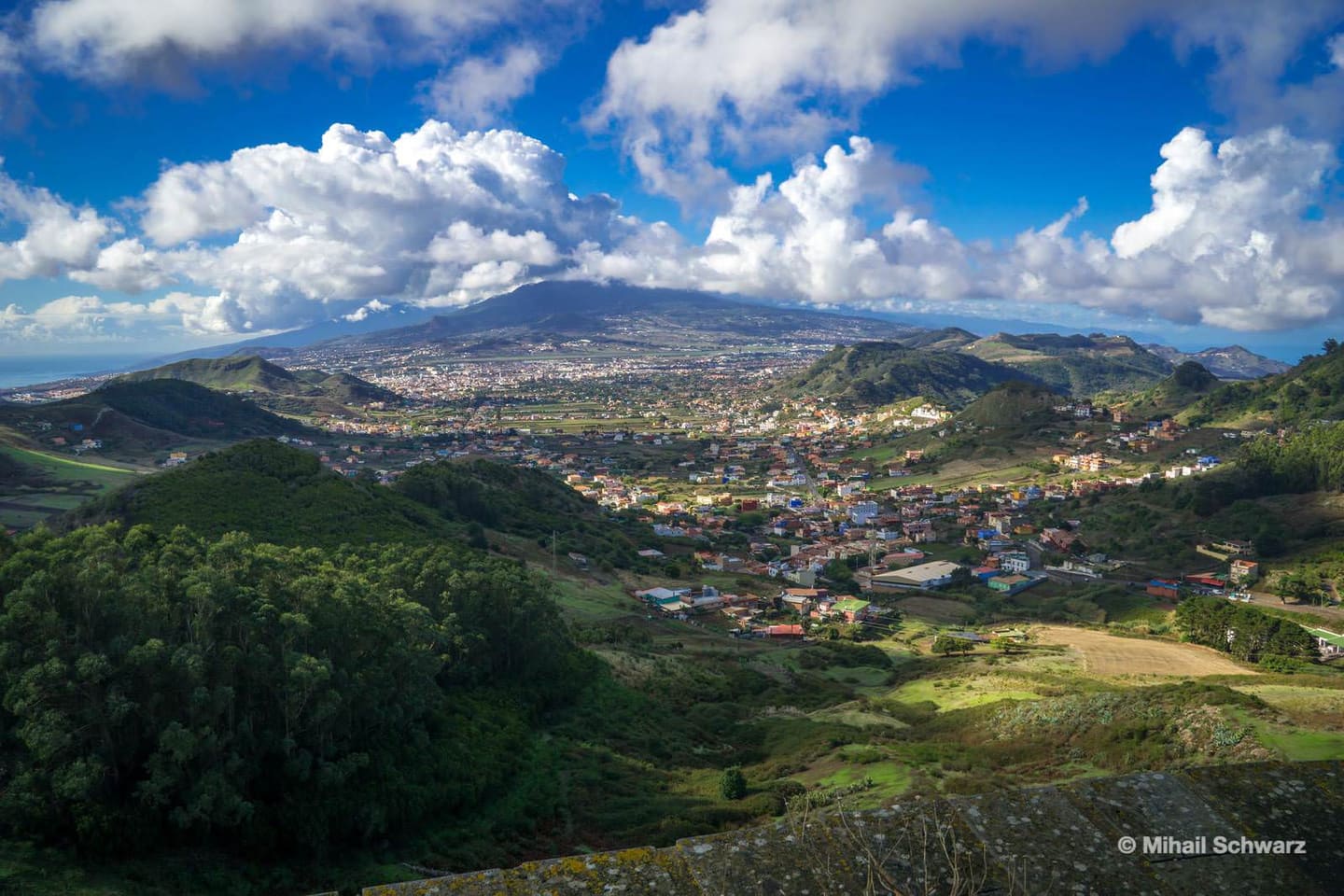
La Orotava sits above the north coast in the Orotava Valley. Its grand houses are a useful starting point, but they make more sense when you understand what paid for them. Fertile land, water and the wine trade shaped a town whose wealth was concentrated among powerful landowning families.
The municipal heritage account places the earlier settlement within the Guanche kingdom of Taoro. After the conquest of Tenerife ended in 1496, the distribution of land and water helped establish the colonial town. Its seventeenth-century prosperity, supported by wine exports, explains the mansions and religious foundations that still define much of the centre.
Those handsome façades tell only part of the story. The council distinguishes the larger houses of Villa de Abajo from the more modest homes of artisans and agricultural workers in Villa de Arriba. I’d keep that contrast in mind: looking beyond the most ornate doorway gives you a fuller picture of how the town worked.
Many surviving traditional buildings date from the eighteenth century, even though that century brought economic difficulty for the vineyards. Later architectural changes added another layer. La Orotava received Historic-Artistic Site designation in 1976; it is a protected historic centre, rather than a resort dressed up with a few old buildings.
For a first walk, use La Concepción church, the town hall area and Calle San Francisco as your anchors. Add Plaza de la Constitución and the gardens rather than trying to tick off every mansion. Church interiors depend on their own opening arrangements; the streets remain worthwhile if a door is closed.
I’d give the outdoor circuit two to three hours, then add time for a house museum and lunch. That is a planning allowance, not an official guided-tour duration. Wear shoes with grip, carry a light layer and leave space for pauses. On a wet day, the paving deserves more attention than your camera screen.
Casa de los Balcones: look beyond the famous façade
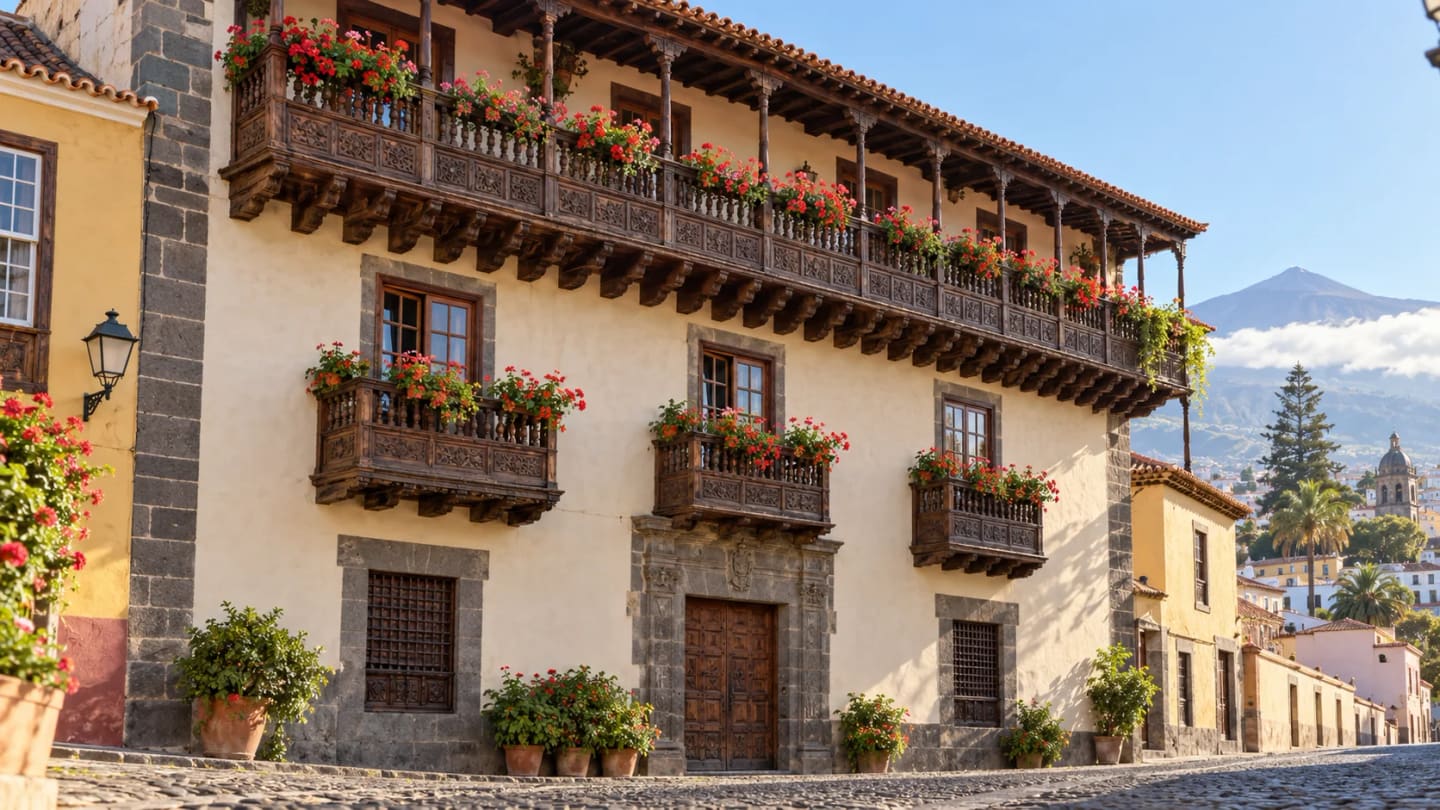
Casa de los Balcones, at Calle San Francisco 3, is the town’s best-known house. The dark timber against pale walls makes the exterior immediately recognisable. Look at the supports, railings and projecting upper balcony: the detail is the reason to stop, rather than simply proving you reached the address.
There is a date worth correcting. Tenerife Tourism’s building record dates Casa de los Balcones to around 1670. It assigns 1632 to neighbouring Casa Jiménez Franchi. Describing the famous balcony house as definitively built in 1632 mixes up two properties; the safer description is a seventeenth-century Canarian mansion.
The same record identifies the long balcony on the third storey as tea, the resin-rich heartwood of pine. The house is three storeys high, but that does not mean three identical tiers of continuous balconies. Notice the difference between individual balcony openings and the long upper gallery, and how the timber gives depth to an otherwise fairly restrained façade.
Inside, the patio is as important as the street view. Open galleries surround parts of the courtyard, and the tourism record describes a substantial wooden wine press. A courtyard is also a different architectural experience from looking at a building through a phone from the pavement.
The attraction centres on traditional life and crafts, including the embroidery associated with La Orotava. Before buying entry, check which museum rooms and demonstrations are included in your ticket. A craft shop, an accessible courtyard and a complete museum visit are separate things; do not assume access to one guarantees access to all three.
I’d pay for the interior if you enjoy domestic architecture and craftwork. If your interest is mainly photography, the façade and surrounding streets may be enough. Confirm current opening hours, admission and stair arrangements directly with the venue before setting off. Historic galleries are not a reliable indicator of step-free access.
Keep moving after your photograph. This is a narrow street used by other people, and standing in the carriageway to fit the entire building into one frame is a poor trade. Nearby traditional houses make the context clearer than a single heavily cropped balcony image.
La Orotava gardens: Victoria terraces and Hijuela del Botánico
Jardines Victoria, also called the gardens of the Marquesado de la Quinta Roja, are the better choice for an ordered garden layout and an outlook across the town. Terraced paths, patterned beds and fountains organise the slope into a series of levels. I’d come here after the houses, when a more open view feels useful.
Tenerife Tourism attributes the nineteenth-century design to the French artist Adolph Croquet. The monument above the terraces was intended as a mausoleum for the Marquis of Quinta Roja, who was eventually buried elsewhere. Its position gives the garden a strong focal point without requiring you to treat it as an occupied tomb.
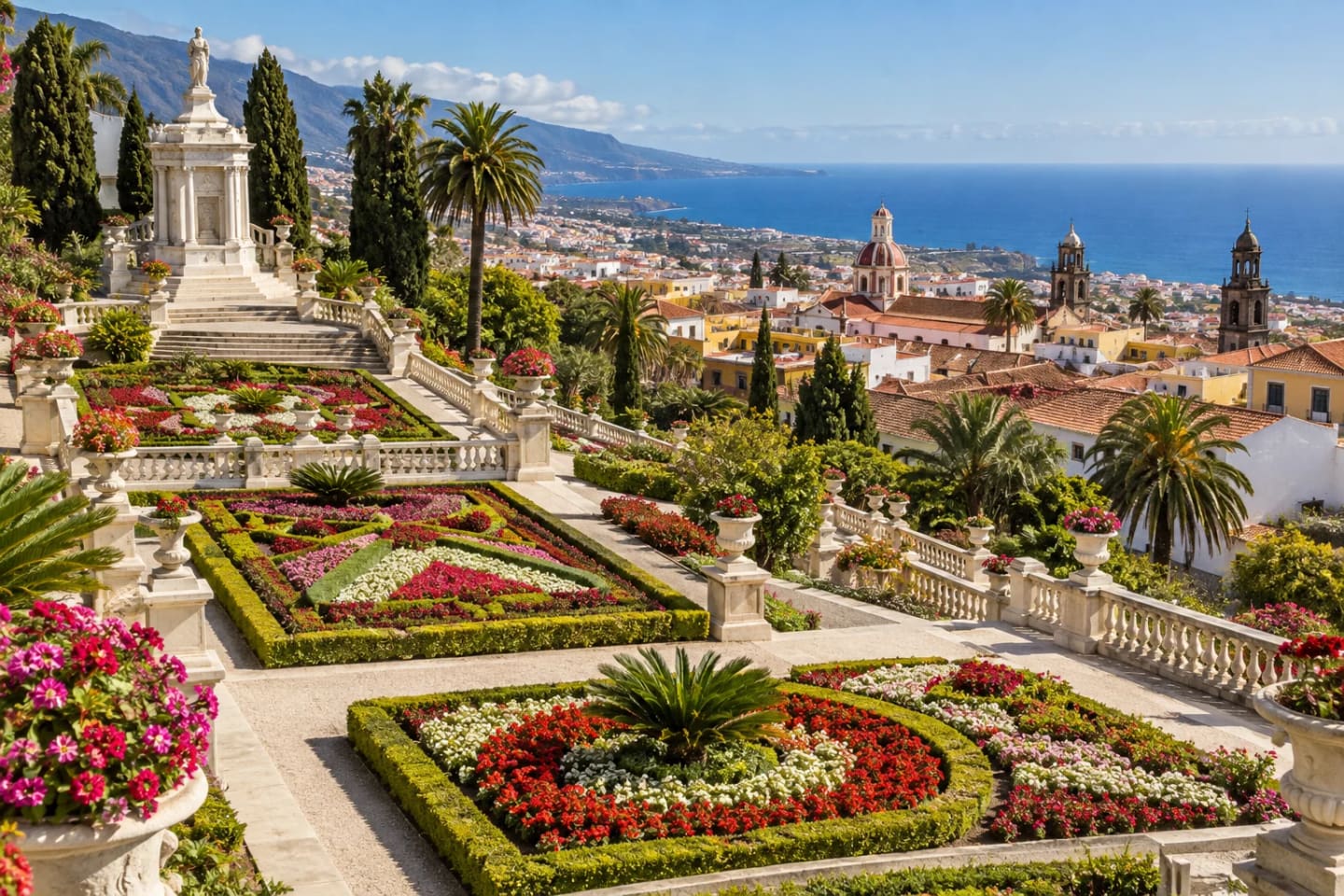
Entry is listed as free by the tourism board. Check local notices for temporary access restrictions rather than interpreting a general listing as a guarantee that every gate stays open. On a clear day, the outlook extends towards the coast; cloud can remove the distant view without spoiling the garden itself.
Hijuela del Botánico offers a different pause near the town hall. Its attraction is the collection of trees and greenery rather than the formal symmetry of Victoria. The council’s garden record explains its development as a nursery garden associated with the acclimatisation garden, using former convent grounds.
Be careful with the name. The larger Jardín de Aclimatación de La Orotava is in Puerto de la Cruz, despite “La Orotava” appearing in its historic name. Hijuela is the smaller garden in this town. Use the precise map pin before walking or driving to either one.
I’d include both when the gardens are a priority: Victoria for terraces and rooflines, Hijuela for a quieter botanical stop. If your time is short, pick one and spend it properly. For reduced mobility, ask about the actual entrance and route; a garden on a hillside can involve steps even when admission is free.
La Orotava flower carpets: Corpus Christi is a particular day
The La Orotava flower carpets are temporary works made for the local Corpus Christi celebrations. They are not a permanent display waiting on the pavement throughout the year. Plan around the council’s programme if seeing their preparation or the procession is the main purpose of your trip.
The municipal anniversary account traces the flower-carpet tradition to 1847, when the Monteverde family decorated the route outside their home. Today the work involves local makers preparing detailed designs along the procession streets. The material is fragile, and its short life is part of the tradition.
Distinguish those street carpets from the larger tapestry in Plaza del Ayuntamiento. That work uses naturally coloured volcanic material associated with Teide, arranged into images rather than planted into beds. From a distance it can resemble a painting; up close, the precision lies in the placement of loose material.
Dates need care. La Orotava celebrates its Octava del Corpus, so the date on a general religious calendar is not enough to establish when the town’s carpets will be ready. Check the local event announcement for the year you are travelling, including the procession and any access changes. I would not book flights around an undated search result.
Go early if you want to watch people working, and give them room. Do not cross barriers or walk onto a carpet for a photograph. Expect your normal sightseeing route to change around the event: crowds, restricted streets and altered transport arrangements are more relevant than an ordinary weekday itinerary.
Outside the festival, visit for the architecture and gardens. You can seek out exhibitions about the carpet-making tradition, but check the current venue and opening arrangements first. A quiet autumn walk and a crowded festival day are both worthwhile possibilities; they offer very different versions of the town.
Lunch in the old town: courtyards, rabbit and valley wine
A lunch stop makes La Orotava more satisfying than a quick balcony detour. Choose somewhere near your walking route so you can sit down without retrieving the car. For courtyard surroundings, Sabor Canario is a useful candidate: Tenerife Tourism lists it in one of the historic quarter’s older buildings.
Use that as a starting point, not a promise about today’s menu. Check opening days, table availability and the dishes being served before committing. If the courtyard matters, ask for that seating specifically. I’d favour a smaller menu that answers your appetite over a long list of vaguely “typical” dishes.
Conejo en salmorejo is rabbit prepared with a seasoned marinade and sauce. Tenerife Tourism’s recipe includes garlic, paprika, vinegar, wine and herbs. It is not the chilled tomato soup also called salmorejo in mainland Spain. Ask about heat and accompaniments rather than assuming every kitchen makes it identically.
For wine, request something from D.O. Valle de La Orotava. The denomination’s regulator identifies Listán Blanco de Canarias as the main variety for its whites. Ask whether the available glass is dry or sweeter; “local white” does not settle that question. If you are driving afterwards, choose an alcohol-free drink or leave the tasting for a day using public transport.
You need not organise a winery visit to understand the connection between town and valley. A meal, a labelled bottle and the history of the houses already make a coherent outing. For a dedicated tasting, book separately and confirm the location: a rural bodega is not necessarily within walking distance of the historic centre.
Getting here from Puerto de la Cruz, and continuing to Teide
La Orotava pairs naturally with Puerto de la Cruz. They are nearby, but I’d allow roughly 15–25 minutes for a drive between central locations, plus parking and the final walk. Treat that as an itinerary estimate: traffic and your exact starting point make a fixed “ten minutes” unreliable.
For buses, TITSA line 345 connects Puerto de la Cruz, La Orotava and Aguamansa. Line 352 follows a circular route through La Orotava and Los Realejos. The checked 352 timetable gives approximately 20–30 minutes between Puerto’s station and La Orotava on many departures, before your walk into the centre.
Check the direction as well as the number, especially on a circular service. Use the current timetable for the return, and allow time to reach the station. The Tenerife bus guide explains the wider planning basics; neither route number is a promise of door-to-door travel from your hotel.
If continuing towards Teide, the TF-21 climbs through the valley towards the mountain. Combine the town with selected stops rather than trying to squeeze a complete museum visit, a long lunch and a major mountain activity into one afternoon. Check weather and road conditions, and handle any Teide cable-car booking separately.
Choose a northern town and your trip format
| Town | Choose it for | Main trade-off |
|---|---|---|
| La Orotava | Wooden balconies, terraces and hillside streets | Steep walking; no town-centre beach |
| La Laguna | A broader historic-city visit and museum choices | More to cover; inland rather than seaside |
| Garachico | A small coastal town and volcanic shoreline | Swimming depends on sea conditions |
| Puerto de la Cruz | Seafront time alongside restaurants and gardens | More resort activity than La Orotava |
North Tenerife excursions
Choose a guided circuit if you want several towns without driving. Check the time allowed in La Orotava, language, entrances and cancellation terms. Compare northern day-trip formats.
Tours from Puerto de la Cruz
Start nearby to reduce transfer time. Confirm the actual collection point, total duration and whether lunch is included. Plan your Puerto-based outing.
Car hire
Choose a car for a wider valley or mountain route. Compare total cost, excess, fuel terms and parking needs before booking. Decide whether you need a rental car.
Questions before visiting La Orotava
Can I visit without paying for attractions?
Yes. The old-town streets and the listed free Victoria Gardens give you a worthwhile visit. Museum entry adds interiors and interpretation; it is not required to appreciate the façades.
Is La Orotava easy with a pushchair?
The steep streets and uneven paving require planning. Choose a shorter route, allow breaks and ask venues about steps. Do not assume every historic courtyard or garden terrace is accessible.
Should I choose La Orotava or La Laguna?
I’d choose La Orotava for balconies and gardens alongside Puerto de la Cruz. Choose La Laguna for a longer city outing with more museum time. Put them on separate days if you want unhurried visits.
Sources for planning your visit
Check Tenerife Tourism’s historic-quarter guide for landmarks, the council’s festival information for dated carpet events, and TITSA for transport. Information was checked on 30 September 2026; confirm venue access and your return departure shortly before travelling.