Puerto de la Cruz, Tenerife, makes most sense when you want a town around your holiday: streets to walk before breakfast, an old harbour, gardens and the green north within easy reach. You can spend a day beside a pool here, but you can also leave the promenade and find a different rhythm a few streets inland. That combination is the reason I would consider it for a northern Tenerife base.
The decision comes with a trade-off. Atlantic waves and northern cloud mean this is a less predictable choice for uninterrupted beach days than the southern resorts. Choose Puerto for its setting and the places you can explore from it, then treat swimming weather as part of the daily plan. Here is how I would organise a stay, from Lago Martiánez and the black-sand beaches to La Orotava, Anaga and Teide.
Puerto de la Cruz or Costa Adeje: choose the right base
Puerto sits on Tenerife’s north coast, below the Orotava Valley. Costa Adeje is on the southwest coast. The distinction affects more than the forecast: it changes the streets outside your hotel, the beaches you use and the journeys you make. Puerto is a town with tourism woven through it; Costa Adeje offers a stronger concentration of resort hotels and holiday facilities.
Puerto was welcoming European travellers in the nineteenth century, long before Tenerife’s southern resort expansion. Its old houses and fishing streets give the holiday a different setting from a newer hotel district. That history matters more than calling one coast “authentic”: Puerto is still a busy tourist town, with apartments and souvenir shops alongside its older buildings.
| Your priority | Puerto de la Cruz | Costa Adeje |
|---|---|---|
| A town to explore on foot | Old streets, squares, the harbour and La Ranilla | Resort promenades and hotel districts |
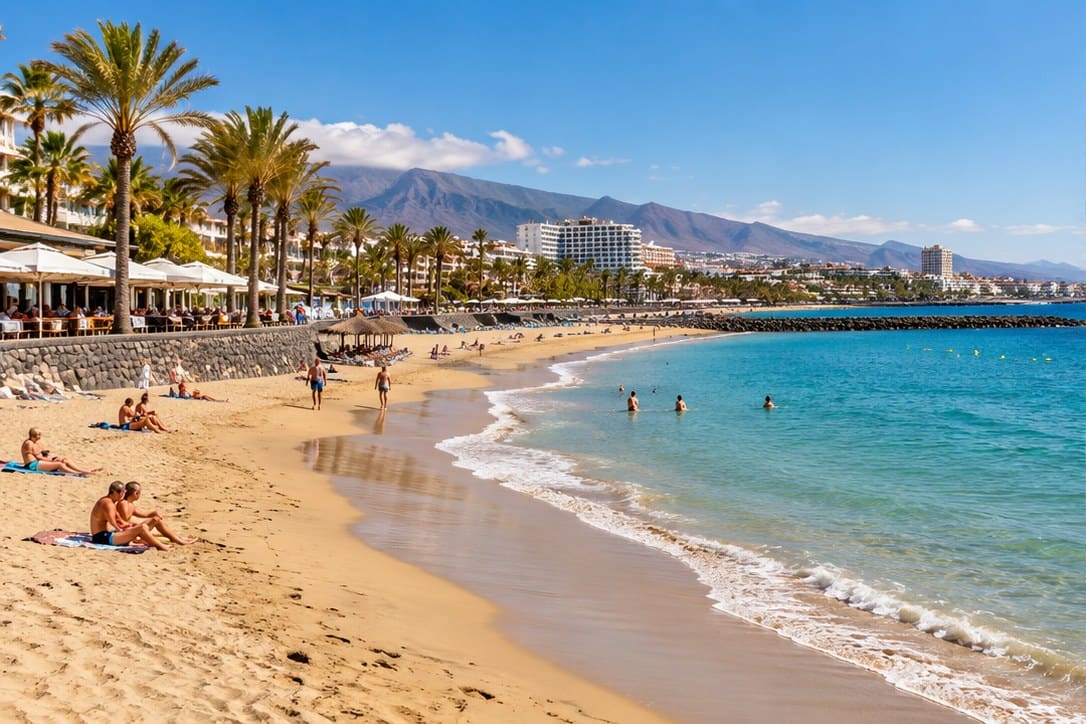
| Beach-focused days | Black sand, exposed Atlantic conditions and changing bathing advice | Generally more suitable for a holiday centred on southern beaches |
| Northern excursions | Convenient for La Orotava and northern routes | Longer journeys to the north |
| Weather preference | More northern cloud and a greener surrounding landscape | Generally sunnier and drier conditions |
| Hotel location | Check hills, steps and the route into the centre | Check the distance from the hotel to the beach and promenade |
| A mixed itinerary | Town walks, pools, gardens and day trips | Beach time, resort facilities and southern activities |
I would choose Puerto if several days of the trip already belong to the north. Driving across the island repeatedly to visit La Orotava or Anaga eats into the time you could spend there. For a longer holiday, dividing your stay between north and south can be a sensible solution; it is less attractive if changing hotels would consume a large share of a short break.
Look closely at accommodation maps. A hotel that appears near the sea may be uphill from it, and the return walk can feel very different with shopping or a tired child. The centre suits walking and evening meals; a hillside hotel may offer more space or a different outlook. Check the actual walking route, rather than measuring a straight line on the map.
A hire car is useful for independent excursions, but I would not make it the centrepiece of days spent in town. Parking and hotel access deserve checking before booking. If you plan mostly to walk, use public transport and take organised trips, a car for the whole stay may add expense without much benefit. Our Puerto de la Cruz excursions guide helps you compare the outings that justify leaving town.
Lago Martiánez: saltwater pools beside the Atlantic
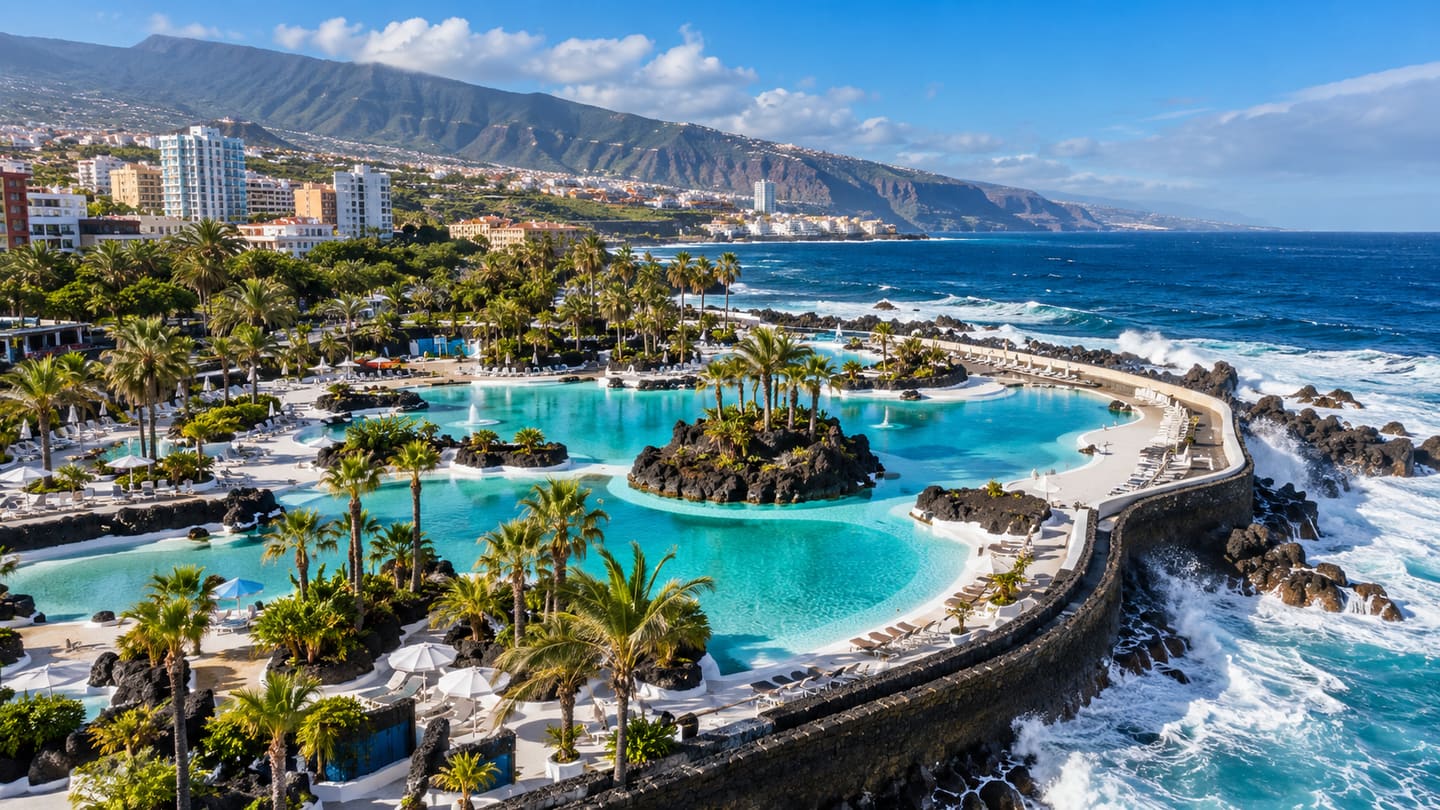
Lago Martiánez is the clearest expression of Puerto’s approach to its coast: a designed place to swim and sit beside an ocean that does not always welcome swimmers. César Manrique helped shape the complex, combining saltwater pools with volcanic stone, planting and sculpture. The appeal is the relationship between those elements and the sea beyond, rather than a pool considered in isolation. See Tenerife Tourism’s Lago Martiánez information for the official visitor overview.
I would allow a substantial part of a day if you want to swim, read and have an unhurried break. Trying to fit the pools between two fixed excursions turns a relaxed stop into a timetable problem. Bring swimwear, sun protection and something comfortable to walk in afterwards; the seafront is an easy place to continue the afternoon when you have had enough of the water.
The published standard adult entrance figure is €5.50 in the tourism tariff sheet, but treat that archival figure as a planning reference and recheck the current tariff, opening arrangements and any closures before going. A price copied from an old itinerary is no guarantee of what you will pay. If you are planning around a particular pool, confirm its availability too: a complex can be open while individual areas are being maintained.
Choose your spot with the rest of the day in mind. Someone intending to read for hours may value shade and a quieter position more than proximity to an entrance. Families may prefer easy access to the appropriate pool and facilities. Walk around before settling, and check the posted pool rules rather than assuming the arrangements match a hotel pool.
For a greener afternoon, consider the Botanical Garden in the upper part of Puerto. Its official name refers to La Orotava, but the entrance is in Puerto de la Cruz. I would give the garden a separate, unrushed visit rather than squeeze it into the end of a pool day.
Lago Martiánez also makes a useful alternative when sea swimming is unsuitable, although pool operation has its own conditions. I would keep it as an option alongside a town walk or garden visit, so a change in beach advice does not leave the day empty. If swimming is essential to your holiday, check hotel pool facilities as carefully as the attractions nearby.
Playa Jardín and Playa Martiánez: black sand and Atlantic conditions
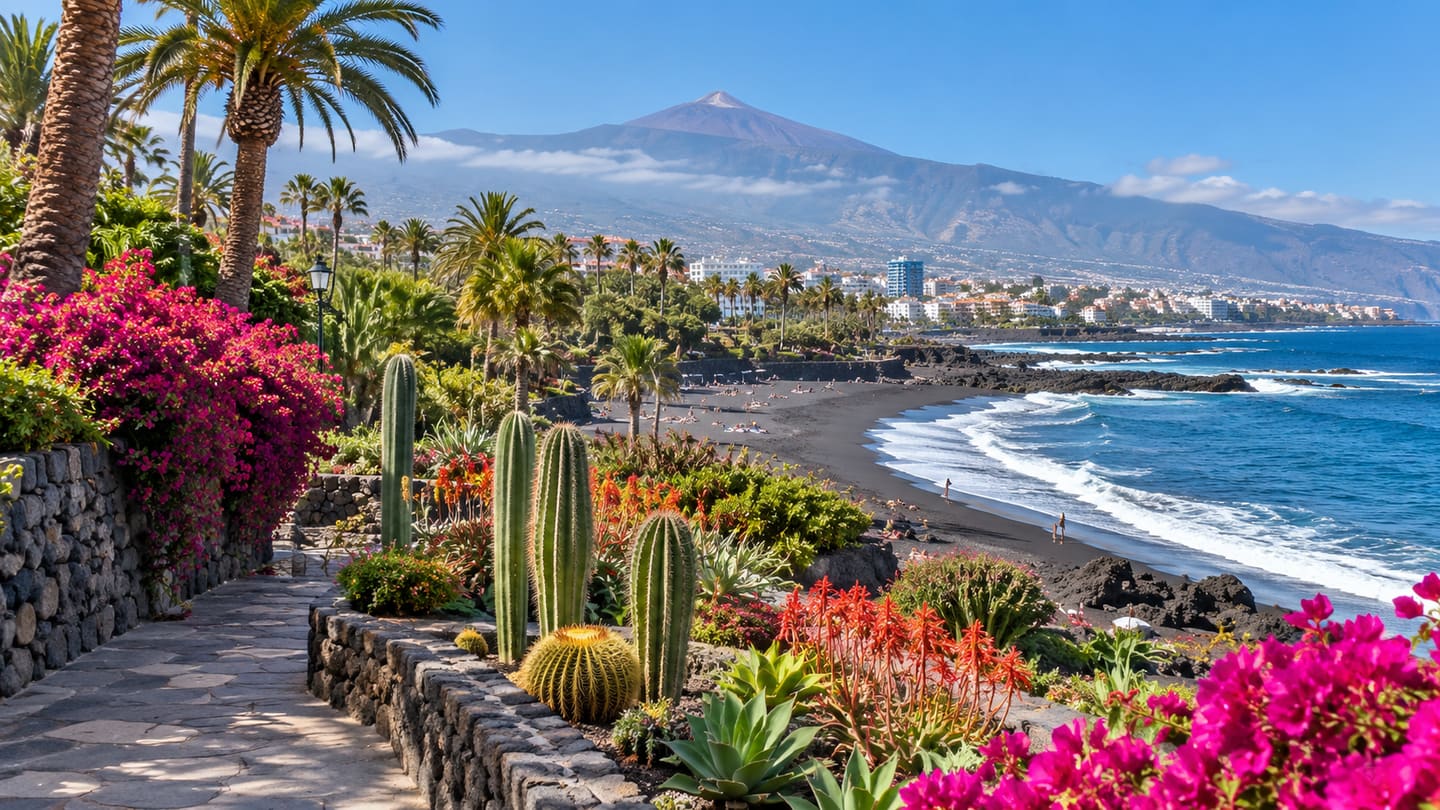
Puerto’s beaches look and behave differently from a sheltered sandy cove. Black volcanic sand, surf and the green land behind the town create a striking coastal setting, but appearance is a poor guide to whether you should enter the water. Make beach choice a decision about conditions, access and what you want to do there.
César Manrique designed Playa Jardín’s gardens around the black-sand beaches, with palms, cactus planting, rocky features and waterfalls. It works as a coastal walk as well as a place to spend time on the sand. I would approach it without making a swim the only measure of a successful visit: walk through the gardens, find a place to sit and leave time for the neighbouring streets. Tenerife Tourism’s Playa Jardín page describes the setting and facilities.
Check bathing restrictions on the day. Playa Jardín has had water-quality restrictions, and advice can change for individual beach areas. A council notice dated 4 September 2026 announced the reopening of Playa Grande and Charcón after a preventive closure. That dated notice is not a promise about your visit. Consult current council updates, read local signs and follow lifeguard instructions. Water quality and dangerous sea conditions are separate reasons why bathing may be unsuitable.
Playa Martiánez lies by the eastern seafront, close to the pool complex. It is associated with surfing and can have substantial waves. Seeing surfers in the water does not establish that it is appropriate for a casual swim: they have different skills, equipment and reasons for being there. If you want a lesson, use a qualified local school and let it assess the conditions and your ability.
For either beach, bring footwear for the walk and avoid assuming that a towel and swimwear are all you need. Sand can become hot in sunshine; conditions can also feel cooler when cloud and wind arrive. A light layer, drinking water and an easy way to carry your things make it simpler to turn a beach visit into a walk.
I would not promise children a sea swim in advance. Explain that flags and conditions decide, with the pool or another activity available if needed. That removes the pressure to make a questionable swim happen simply because it was the original plan. Our guide to Tenerife’s best beaches offers other coastal options if a particular type of beach day matters to you.
The old town: Plaza del Charco, La Ranilla and the harbour
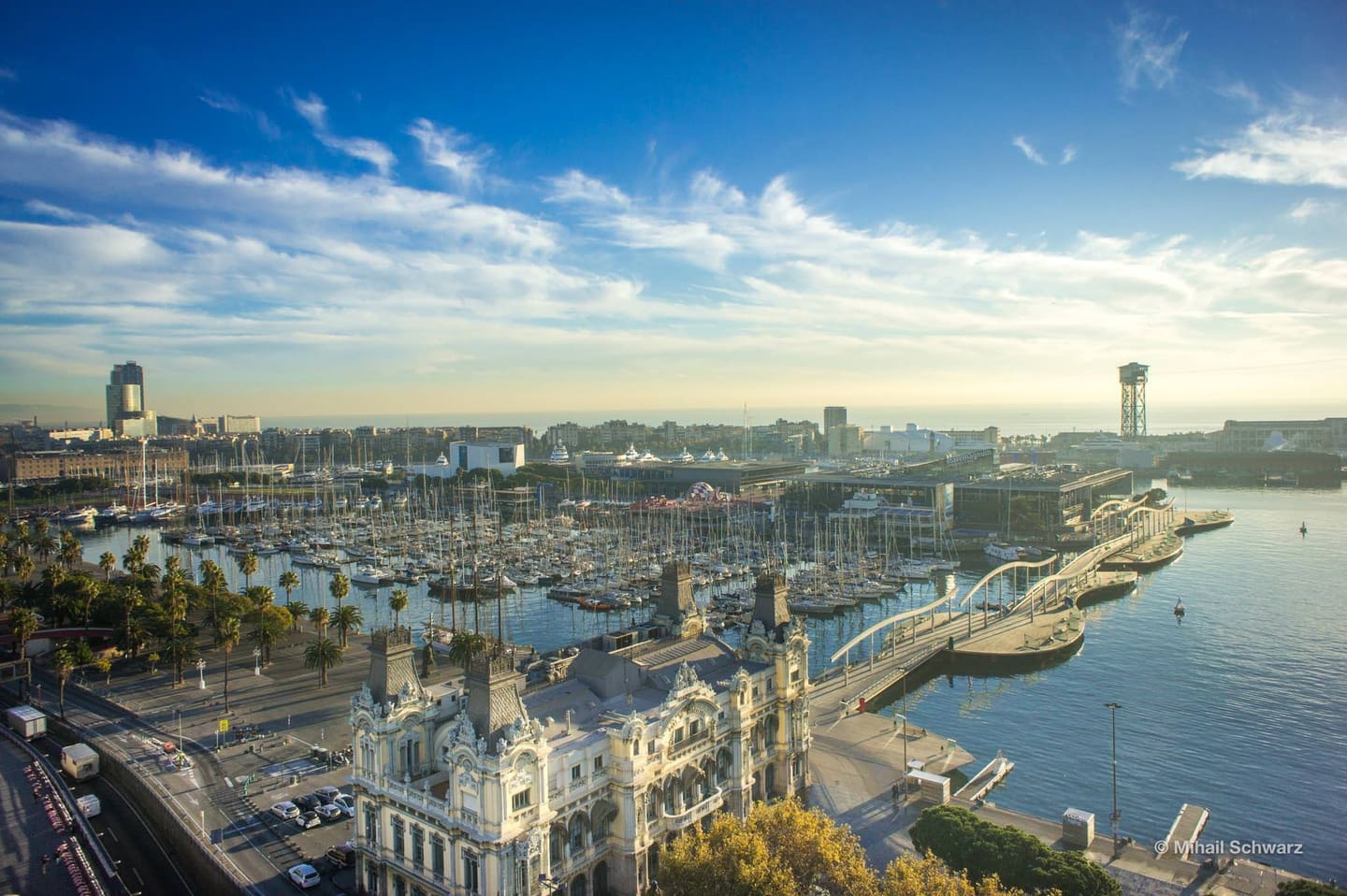
The old town is where I would leave the itinerary loose. The tree-shaded Plaza del Charco gives you an easy reference point, with streets leading towards the sea and into the surrounding neighbourhoods. Look for wooden balconies, traditional houses and the old customs building, Casa de la Real Aduana, near the fishing harbour. Begin there, walk towards the fishing harbour, then continue into La Ranilla. You can cover the area without a complicated route, but rushing through it misses the reason to come.
The harbour is a working part of the town as well as a place visitors photograph. Give people room around boats and equipment, and keep an eye on the sea when walking beside the water. Choose a viewpoint for a short pause rather than treating the harbour edge as a place to spread out with bags and food.
La Ranilla suits a slower wander through streets with murals, shops and places to eat. Let a side street interrupt the route. Look up at the façades as well as the murals; the small-scale streets are the reason to slow down here.
For lunch, I would compare the tapas bars and fish restaurants around La Ranilla before choosing a terrace. Papas arrugadas are the small wrinkled potatoes served with mojo; grilled fish makes sense if you want a simple meal. Ask which fish is available and whether the price is per portion or by weight. The harbour setting alone does not prove that everything on a menu was caught locally.
Build an evening around the town too. An afternoon excursion does not have to end with another long drive to dinner. Return, put the car away and walk to a meal. If your hotel is uphill, decide in advance whether the return journey will be a walk or a taxi; that small practical choice matters more after a full day than it does when browsing a booking map.
For a first day, this is a useful orientation circuit: Plaza del Charco, the harbour, La Ranilla and a seafront stroll. Keep any timed attraction for another day. You will learn where you want to return, identify a few useful shops and work out the walking distances from your accommodation. The town becomes much easier to use once those distances are real rather than dots on a screen.
Northern weather and the panza de burro cloud cap
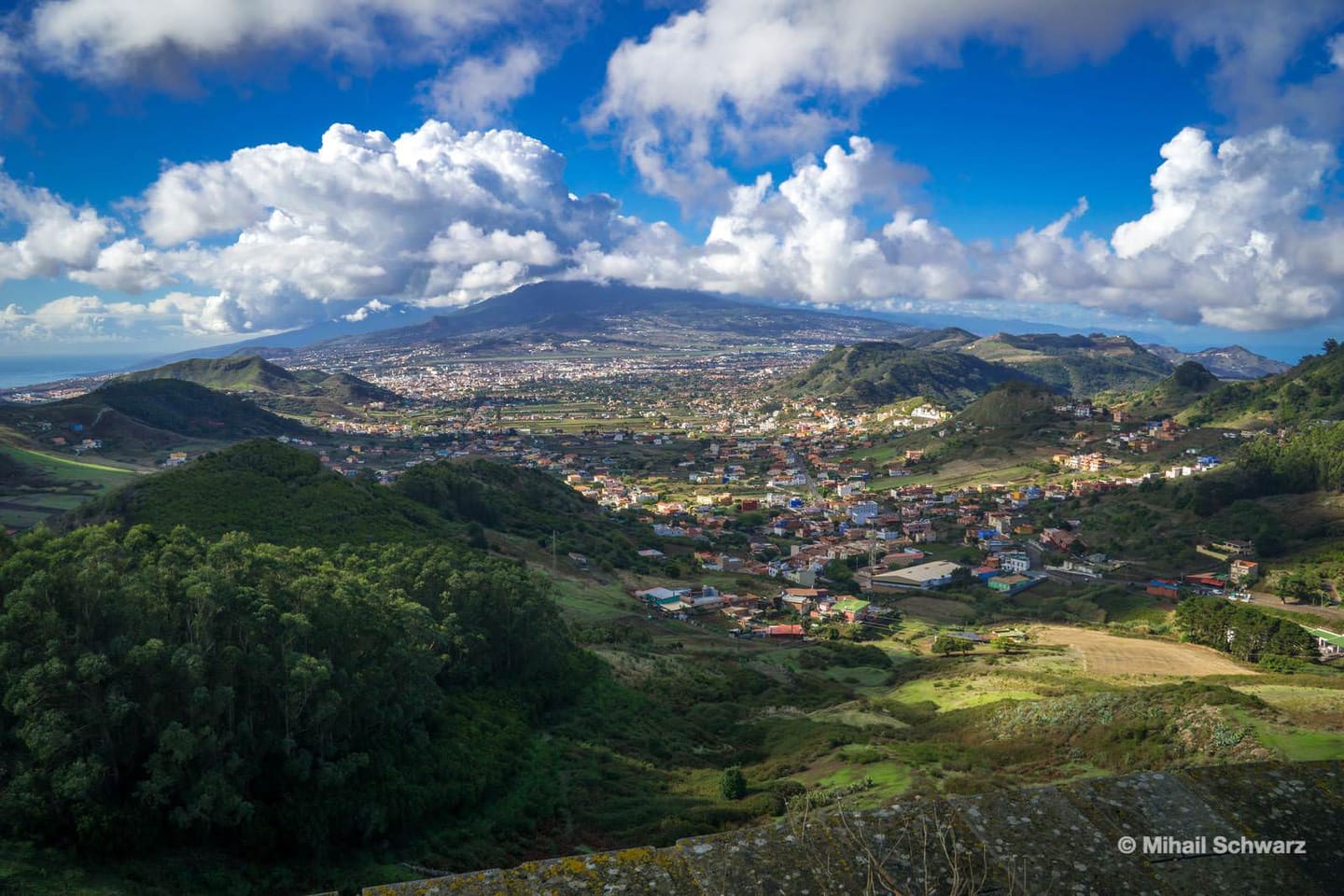
Puerto’s climate is part of its appeal and part of the compromise. Trade winds can bring moist air against Tenerife’s northern slopes, producing the low cloud often called panza de burro, or “donkey’s belly”. The same northern exposure helps explain the greener landscape. A cloud layer over the coast does not necessarily tell you what the sky is doing higher on the island.
For holiday planning, the useful consequence is variability. You may have mild conditions, cloud, sunny intervals or rain during a stay. Puerto is not a place where I would guarantee either constant heat or uninterrupted sunshine, and a southern forecast is not a reliable substitute for a northern one. Check the forecast for the places you will actually visit.
Pack for small changes without turning the suitcase into an expedition kit. A light layer and a compact waterproof are useful alongside summer clothes; comfortable walking shoes matter if you intend to explore towns and trails. Higher mountain excursions require a separate look at the forecast and the operator’s clothing advice. What feels suitable beside the sea may be inadequate at altitude.
I would avoid fixing every outdoor activity to a particular day before arrival. Keep a town walk, pool visit and indoor option in reserve, then use the better conditions for the outing that needs them. A cloudy morning in Puerto is not automatically a reason to drive south, especially if your chosen northern destination has a different forecast.
Sun protection still belongs in the bag on a cloudy day. More broadly, judge comfort by temperature, wind and exposure, rather than the colour of the sky alone. Keep the day adjustable: have a destination, know the alternatives and allow the weather to change the order.
Excursions from Puerto: Loro Parque, La Orotava, Anaga and Teide
Loro Parque is the local major attraction to consider if an animal park fits your interests. I would allocate its own day rather than attach it to a long drive elsewhere. Check current opening times, ticket categories and visit information with the operator, and think about how much time your group enjoys spending at this type of attraction. The current price belongs on the official booking page, where the ticket conditions can be read alongside it.
La Orotava is a much smaller travel commitment. Allow roughly 20 minutes by car as a planning estimate from Puerto, with the actual time depending on your starting point, traffic and parking. The attraction is spending time in the historic town, not reaching it as quickly as possible. Put La Orotava on your shortlist for Canarian balconies and historic streets.
Anaga needs a different calculation. A 60–90-minute drive is a more useful rough allowance than twenty minutes, depending on the route and destination. The massif is a large area, so choose a particular walk or viewpoint before estimating travel. Read our Anaga guide, check any route-specific access requirements and avoid combining a substantial walk with too many distant stops.
Teide is another separate day. Northern routes take you from the coastal surroundings towards a much higher volcanic landscape, where weather and road conditions need their own checks. Decide whether you want a drive through the national park, a guided excursion, a cable-car trip or a permitted mountain walk. Those are different plans. Cable-car operation is conditional on weather and operating conditions; a ticket does not guarantee access to the summit, which has separate permission requirements.
For an organised trip, verify the northern pickup point, departure time and what happens if the cable car cannot run. Volcano Teide lists pickup arrangements for Puerto de la Cruz and La Orotava on its tour information. Read the current package details and restrictions before paying, particularly if altitude or mobility affects anyone in the group. I would book the excursion around those requirements and keep another day available for weather changes.
Compare excursions from Puerto de la Cruz
Choose a northern outing by journey time, transport and the kind of day you want. Start with the local excursion guide before filling your calendar.
Explore excursions from PuertoLoro Parque tickets
Read the operator’s current ticket options, prices and visitor information. Allow a dedicated day if this attraction suits your group.
Check official Loro Parque ticketsTeide tour with cable car
From €92 when checked on 30 September 2026 · about 7 hours · northern pickup, guide and cable car. Free cancellation until 24 hours before departure; confirm your selected option. Summit access is separate.
Check the official Teide tourSources and checks before your visit
Facts and booking details checked on 30 September 2026 against Tenerife Tourism, the linked council notice and attraction operators. Recheck beach advice, pool access and your selected ticket before travelling.