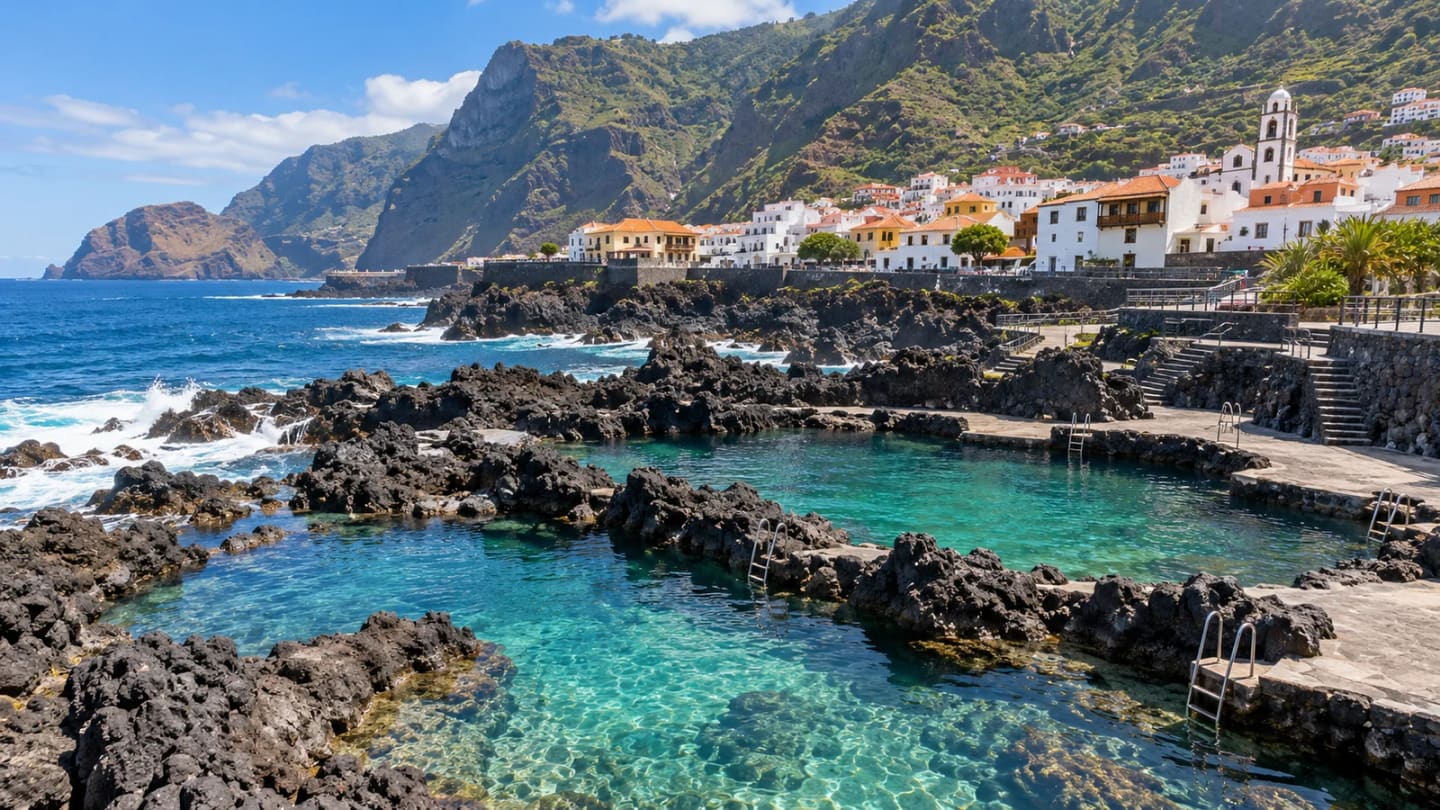
Garachico, Tenerife, is a north-coast town where a ruined trading harbour became a shoreline of lava pools. I’d choose it for a slow walk, volcanic history and a fish lunch, with swimming at El Caletón as a bonus when the sea allows. It rewards an unhurried half-day more than a hurried photograph stop.
The catch is the Atlantic. Garachico natural pools are open to changing swell, and a sunny morning does not guarantee safe bathing. Plan a day that still works without entering the water: the compact centre, harbour remains and neighbouring towns give you plenty to do.
Garachico volcanic history: what happened in 1706?
Garachico’s waterfront makes more sense once you know what disappeared. In the sixteenth and seventeenth centuries, this was a major commercial centre, with a harbour linking Tenerife’s agricultural economy to overseas markets. Wine was part of that trade; the town’s handsome buildings are evidence of wealth rather than a purpose-built holiday development.
The Trevejo eruption began on 5 May 1706. Lava descended towards the coast, buried the old harbour and damaged part of the town. The result was an economic disaster as well as a change in the landscape: losing a usable port undermined the business that supported Garachico.
You’ll also encounter the names Arenas Negras and Montaña Negra in accounts of the eruption. Avoid imagining a single volcano exploding beneath the square. The important relationship is between the eruption inland, the descending lava and the shoreline it reshaped. Nor was every building erased in one night; surviving and rebuilt structures are central to what you see today.
Tenerife Tourism’s historical overview explains the loss of the harbour. For a tangible reminder, include Puerta de Tierra, associated with the former port, in your walk. Standing inland from today’s waterline helps you picture how much the coast changed.
Then look towards the dark rock beside the sea. The same volcanic event that destroyed the town’s commercial advantage created the setting for its best-known bathing area. That doesn’t make the disaster a happy accident; it shows how a place can acquire a different identity over centuries.
I’d start with the harbour story before photographing the pools. Otherwise, it’s easy to treat the black rock as attractive scenery and miss why the castle, old streets and sea sit together in this unusual arrangement. Garachico is a useful place to understand Tenerife beyond beaches and the summit of Teide.
El Caletón Garachico: swimming in the lava pools
El Caletón is a group of natural rock pools beside Castillo de San Miguel. The lava shoreline forms irregular basins, with built paths, steps and access points making parts of the coast easier to use. These are seawater pools, not heated baths or a conventional swimming complex.
Tenerife Tourism describes El Caletón as a natural bathing area. The appeal is the contrast between dark basalt and clear water. The practical complication is that the pools remain connected to the ocean: their appearance and usability change with tide and swell.
Check the entire setting before choosing a pool. Watch waves reach the outer rocks, look for posted restrictions and identify a safe way back out. An inviting pocket of water is no help if the next wave washes across its approach. Obey barriers, flags and any staff instructions; never step around a closure for a photograph.
Tide tables provide context, but they don’t give permission to swim. A lower tide can expose awkward rock and shallow areas; a higher tide can let waves reach places that appeared protected earlier. Swell direction and strength matter too. There is no reliable rule that one particular tide makes every Garachico rock pool safe.
Use designated access rather than scrambling across the lava. Wet surfaces can be slippery, and underwater ledges make jumping or diving a poor choice. Water shoes can help with rough edges, but they cannot protect you from a wave. Keep a clear exit and leave enough room for other swimmers using the steps.
For children, choose supervision over adventurous exploring. An adult should remain close enough to help, and small children should not play on exposed outer rocks. If anyone in your group is uncertain about swimming, make this a waterfront visit. Watching the sea from a permitted dry area is a complete activity in itself.
Pack a towel, drinking water, sun protection and shoes suitable for the town as well as the pool approaches. Don’t plan to leave valuables unattended on the rocks. If conditions change after you arrive, shorten the swim; the rest of Garachico is close enough to rescue the afternoon.
My recommendation is to decide about bathing after arriving, rather than building the whole journey around it. On a calm day, leave time to enjoy the water. On a rough day, move inland to the square and have lunch. Neither a tour booking nor a long drive obliges you to swim.
Historic centre: Plaza de la Libertad, San Miguel and Santa Ana
A straightforward walking route joins the waterfront to Plaza de la Libertad, then lets you explore the adjoining streets without repeatedly returning to the car. Allow roughly an hour for an easy outdoor circuit, more if buildings are open and you want to go inside. That is a planning allowance, not a guided-tour duration.
Castillo de San Miguel is the small coastal fort near the pools. Its construction was authorised by Philip II in 1575, according to Tenerife Tourism’s castle record. It survived the eruption, although the harbour it protected lost its former role. Look at its position before judging its modest size: defence depended on controlling the waterfront.
Head towards the square for Santa Ana church. Construction began in 1520; the building was badly affected by the 1706 eruption and subsequently reconstructed. The official church description distinguishes that history from the tempting claim that everything you see survived untouched.
The former San Francisco convent, facing the central square, adds another layer to the walk. Together, the religious buildings, houses and public spaces explain why Garachico deserves time beyond the pools. Check access locally rather than assuming every historic doorway leads to an attraction open throughout the day.
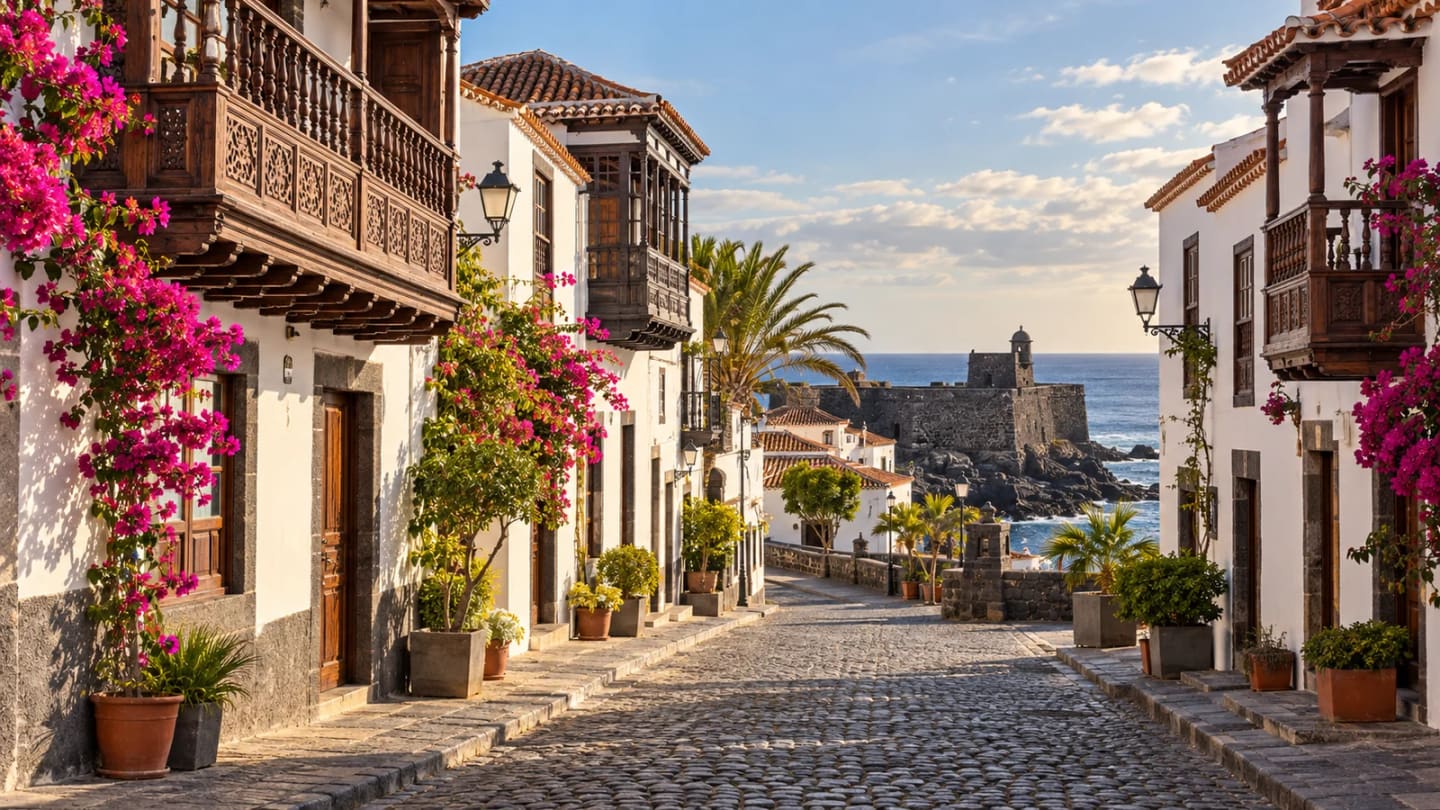
I’d leave a little time for streets between the landmarks. Timber balconies, doorways and the relationship between the square and waterfront are easier to appreciate at walking pace. Keep clear of residential entrances and don’t treat every courtyard as public space.
The official old-town guide is useful for extending the circuit. If you have limited mobility, separate a stroll through the centre from access to the rock pools: manageable streets do not imply step-free bathing. Ask about individual buildings and entrances before committing to a longer route.
Canarian food: make room for a proper lunch
Garachico suits a lunch stop because eating can sit between a town walk and an optional swim. Waterfront terraces offer a sea view; the streets around the centre give you alternatives if wind or spray makes that view less comfortable. Choose the table for the conditions, not just its position on a map.
For a straightforward Canarian meal, look for fish, papas arrugadas and mojo sauces. The potatoes are usually served with their skins; mojo brings the flavour, with green and red versions common on local menus. Ask what fish is available that day rather than assuming a printed menu proves a fresh local catch.
Whole fish needs a price check before ordering. Confirm whether the menu charges by portion or weight, what size the kitchen suggests and whether potatoes or salad are included. That small conversation is more useful than a guide’s unsupported promise of a cheap lunch. Ask about bones if you’re ordering for children.
A terrace is also worth judging for shelter and service. A shaded table away from the busiest crossing can be preferable to the front row beside traffic. If your group has dietary requirements, ask before settling in; a traditional menu does not automatically mean several vegetarian mains.
Local wine makes sense here because wine exports were part of the old port’s story. Tenerife Tourism’s wine history connects Garachico with that trade. Ask for a Tenerife wine by the glass and let the restaurant explain the bottle’s origin rather than assuming every house wine comes from nearby vineyards.
For drivers, keep the lunch alcohol-free or nominate someone who will not drink. A leisurely meal is pleasant; negotiating unfamiliar bends afterwards needs full attention. Leave room for coffee and a short walk before the next town, rather than fitting lunch into a rushed twenty-minute stop.
Getting to Garachico: driving, buses and parking
From Puerto de la Cruz, the normal approach follows the northern road network towards Icod de los Vinos, then the TF-42 coast towards Garachico. From southern resorts, a usual route uses the TF-1 towards Santiago del Teide, then the TF-82 and northern connections towards Icod. Check current navigation and road notices before leaving.
Don’t assume the route through Masca is the simplest alternative. The mountain road is winding, and adding it changes an ordinary transfer into a separate excursion. Read the Masca guide before choosing that detour. If mountain driving makes you tense, a guided trip can be the more relaxing use of the day.
For parking, look for signed areas around the waterfront and near the modern port rather than pushing into the old centre. The municipality’s mobility study identifies parking around the port and other larger areas. These documents are background, not a guarantee of today’s spaces or charges.
Waterfront parking can be free where current signs permit it. Check restrictions, markings and temporary notices; don’t assume every space beside the sea is free or unrestricted. Leave nothing visible in the vehicle. Once parked legally, the compact centre is better explored on foot.
Without a car, TITSA line 363 normally links Puerto de la Cruz, Icod, Garachico and Buenavista del Norte. Check the official route and timetable and the return journey before departure. TITSA also publishes a Garachico diversion notice; confirm which stops currently operate rather than relying on the usual route.
A north-west day: Icod, Garachico and Buenavista
From Puerto de la Cruz, a sensible geographical sequence is Icod → Garachico → Buenavista, returning towards your base afterwards. Start with the Icod de los Vinos guide if the dragon tree and town are priorities. Decide in advance whether you want a paid attraction visit or simply a shorter walk.
Give Garachico the middle of the day: walk through the centre, assess El Caletón and have lunch. Keep bathing optional so a closure doesn’t unravel the itinerary. A two-hour allocation works for a compact visit; a swim and sit-down meal deserve more breathing room.
Continue west to Buenavista if you still have time and energy. A short town stop is enough to change the pace after Garachico’s waterfront. Don’t automatically append Punta de Teno: access arrangements and transport require their own planning, and an extra destination can turn a relaxed route into a timetable exercise.
From the south, you can build a broader circuit via Santiago del Teide and Icod, with Garachico and Buenavista as the northern stops. A return through Masca is an optional mountain-road choice, subject to current access, rather than an essential part of a “complete” day.
I’d choose three places and enjoy them properly. Adding Teide, a gorge hike and a sunset stop to this itinerary leaves very little room for lunch or delays. Use the Tenerife day trips comparison if you prefer a guided circuit, and check how much time the itinerary actually allows in Garachico.
Garachico, Bajamar or Mesa del Mar?
Choose by the day you want, then check conditions. None of these Atlantic bathing places guarantees a swim.
| Place | Strongest reason to choose it | Practical catch |
|---|---|---|
| Garachico / El Caletón | Irregular lava pools beside a historic town | Steps, wet rock and ocean swell; easy to switch to sightseeing |
| Bajamar | Equipped pools, including a children’s pool and adapted access | Facilities don’t remove the need to obey closures and sea warnings |
| Mesa del Mar | A coastal pool stop in Tacoronte | A separate journey from Garachico; check bathing access before descending |
The official Bajamar description lists ramps, changing facilities and pools of different sizes. For Mesa del Mar, check the current local situation. I’d pick Garachico when the town matters as much as the water, and Bajamar when adapted access is the first question.
Choose a tour or your own car
Island circuit tour
Useful for a first overview without mountain driving. Compare the actual stops, pickup area, walking requirements, inclusions and cancellation terms; a short Garachico stop rarely leaves room for swimming.
Compare island day tripsHire a car
Choose this for a longer lunch and flexible time in Icod and Buenavista. Compare the total hire cost, insurance excess, deposit, fuel policy and cancellation conditions before booking.
Decide whether to hire a carMasca and Garachico excursion
Choose an itinerary explicitly including both towns. A village stop in Masca is not a gorge hike; confirm pickup, duration and free time before paying.
Plan Masca with GarachicoThese guides help you compare the format before choosing a dated offer. For a swimming-focused day, independent transport normally gives you more control over timing than a multi-stop coach itinerary.
Frequently asked questions
Is Garachico worth visiting without swimming?
Yes. The old centre, castle exterior, harbour history and lunch options make a worthwhile half-day even when El Caletón is closed.
Are Garachico natural pools always open?
No. Sea conditions and local restrictions determine access. Check on arrival and obey closures rather than treating a photograph or tide forecast as permission.
Can you visit Garachico without a car?
Yes, normally using TITSA 363 from Puerto de la Cruz or Icod. Check current diversions, working stops and the last suitable return service first.
How long should you allow in Garachico?
Allow two to three hours for the centre and lunch, and longer for swimming. With limited time, prioritise the waterfront and square rather than adding every nearby attraction.
Sources and checks before travelling
Historical and landmark details were checked against Tenerife Tourism; transport against TITSA; parking context against the municipal mobility study on 30 September 2026. Linked official pages above provide the supporting detail. Recheck road access, bus notices and bathing restrictions shortly before travelling.