San Cristóbal de La Laguna is Tenerife’s old capital and its most rewarding town for an easy architectural walk. Choose it for colourful houses, shaded courtyards and a proper café stop rather than sea views. The compact historic centre works well as a half-day outing from Santa Cruz, with enough museums and food stops to fill a slower day.
Written and reviewed by Mihail Schwarz. Heritage and transport sources checked on 30 September 2026.
Why San Cristóbal de La Laguna is a UNESCO city
La Laguna’s importance lies in its street plan as much as its individual buildings. UNESCO’s World Heritage listing, inscribed in 1999, describes an early unfortified Spanish colonial town whose layout influenced settlements in the Americas. You can appreciate that idea on foot: crossing streets connect squares, religious buildings and substantial houses without a defensive wall enclosing everything.
The city developed with two distinct parts: an earlier, less regular Upper Town and a more planned Lower Town. That makes “a perfect grid” too simple a description. Look at a street map before walking and you’ll see both the organised network and the variations within it. The heritage designation recognises a whole urban arrangement, not just a collection of photogenic façades.
You’ll sometimes find La Laguna called the direct prototype for Havana or Lima. The wider American connection is well documented, but a neat claim that those particular cities copied this one needs more evidence. The useful thing to take away is the planning principle: a colonial settlement organised around civic and religious spaces, with streets and plots that could be adapted elsewhere.
For a first visit, I’d give the old town a morning and lunch. Architecture enthusiasts should keep the afternoon for a museum or a guided explanation of the houses. If your main interest is a beach or a dramatic landscape, make La Laguna the cultural part of a wider Tenerife itinerary rather than expecting those experiences within the centre.
A walking route along Calle San Agustín and Obispo Rey Redondo
Start at Plaza del Adelantado. The square gives you an immediate sense of the town’s civic scale, with Palacio de Nava and neighbouring historic buildings around it. Pause here before diving into narrower streets: it’s easier to understand the route with a clear starting point than to follow isolated map pins across the centre.
From the square, follow Calle Obispo Rey Redondo towards the cathedral. You may also see the traditional name Calle de la Carrera on maps and local descriptions. Use both names when orientating yourself. This street links major sights naturally, so there’s no need to keep zigzagging back to the square whenever you want the next landmark.
Continue towards the La Concepción end of the old town, then make your way onto Calle San Agustín for the return. These parallel streets give the walk a simple shape. Allow roughly two hours as a planning estimate for strolling, looking at façades and stopping for coffee; add time separately for any museum or cathedral visit. A determined march would miss the reason to come.
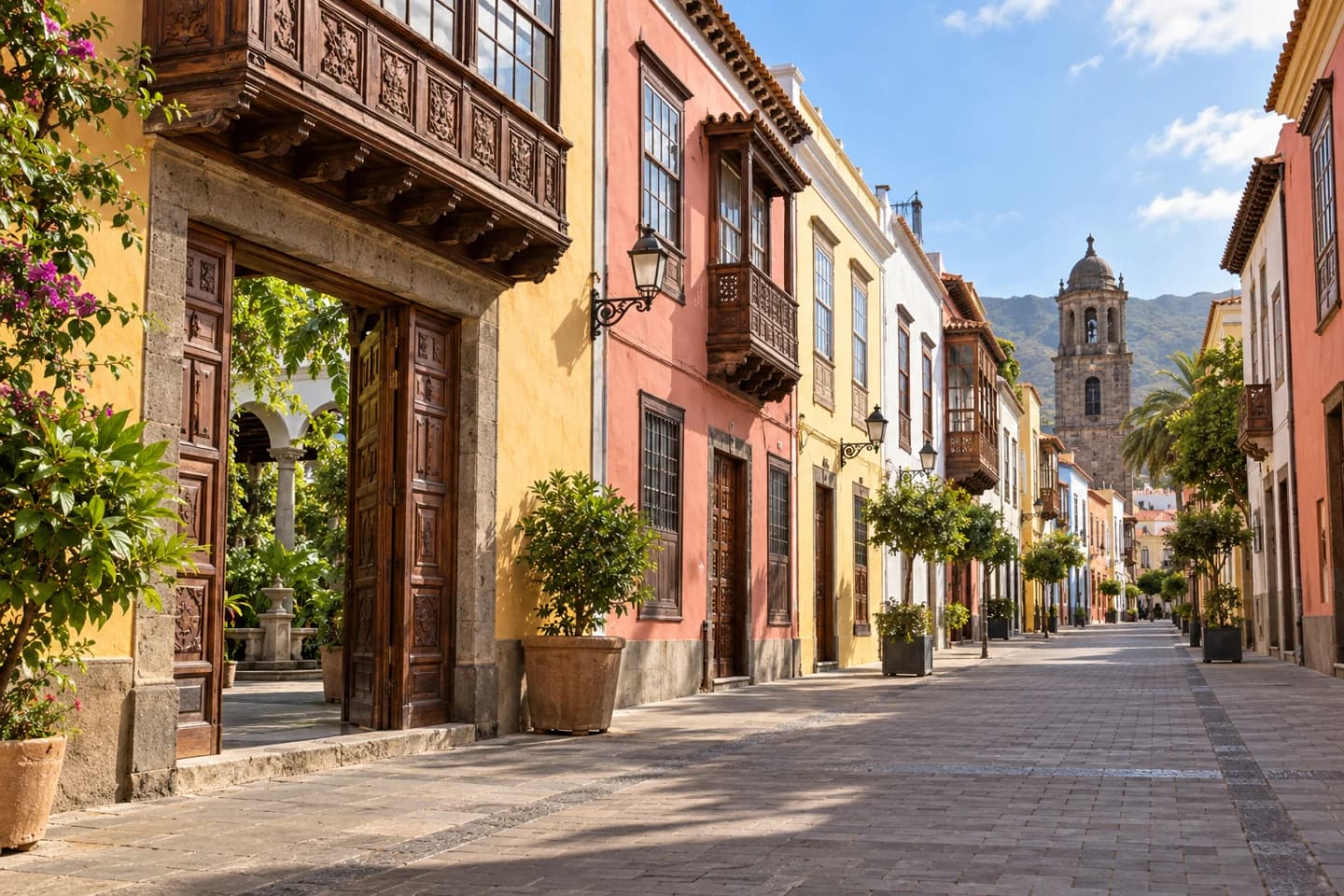
The architecture rewards small observations. Look for the contrast between painted walls and dark stone door surrounds, window shutters, carved woodwork and the depth of entrance halls. Wooden balconies and galleries are part of the Canarian architectural vocabulary, but don’t assume every visible balcony is the same age or made from the same species of timber.
Patios are another reason to slow down. A street façade can conceal a much richer interior arrangement, with galleries around an open central space. Choose a building with authorised visitor access if you want to see that properly. An open doorway is not permission to walk into a private home, and an attractive courtyard may belong to a working office rather than an attraction.
Comfortable shoes make more difference than a detailed itinerary. Pedestrian streets remove much of the traffic friction, but paving, thresholds and occasional changes of level still matter. With a pushchair or reduced mobility, focus on the outdoor circuit and ask individual venues about accessible entrances before committing to an interior visit.
The cathedral, Palacio de Nava and Casa Lercaro
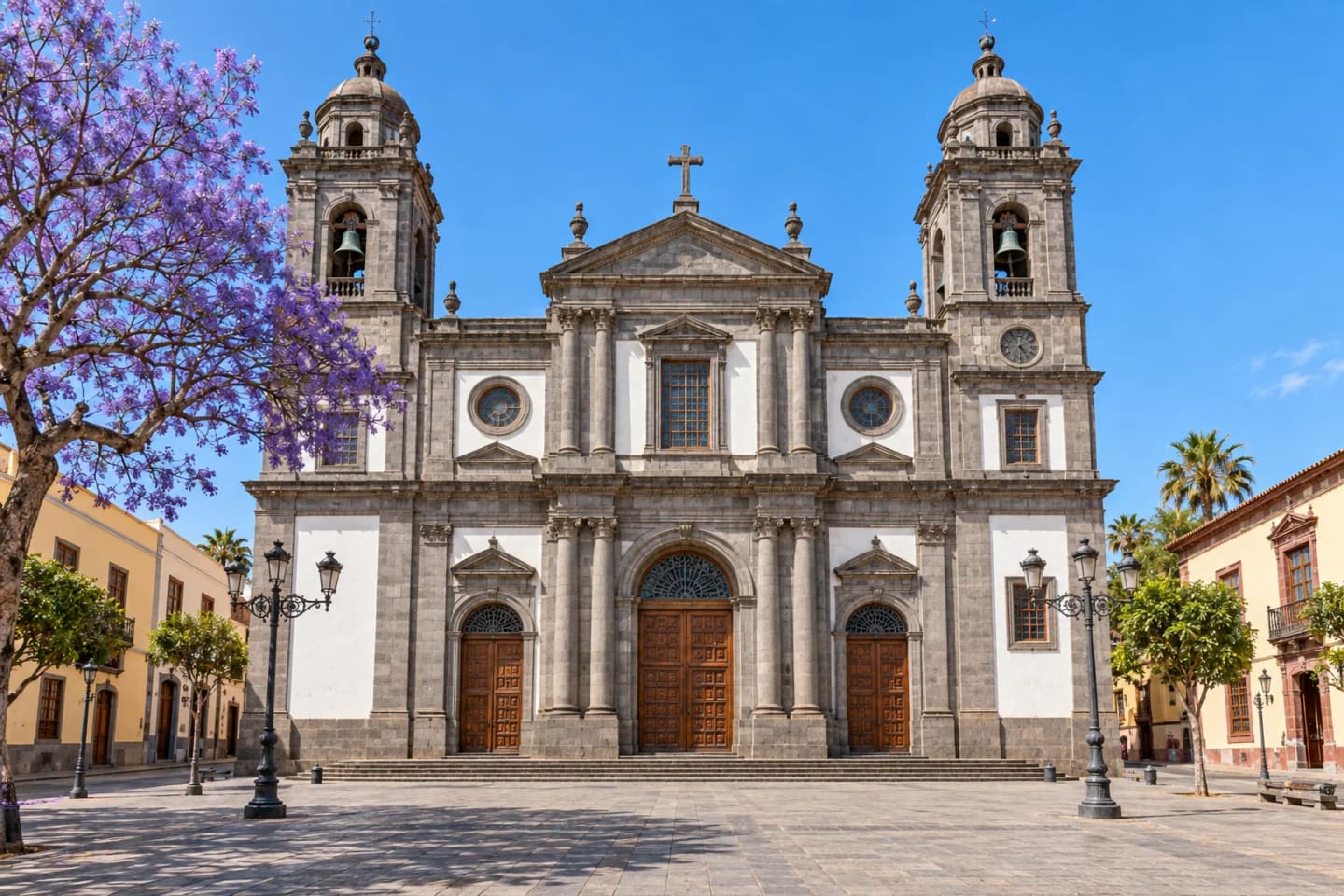
Catedral de San Cristóbal de La Laguna
The cathedral’s stone façade is a useful landmark on the walking circuit, but the building should not be treated as one untouched early colonial monument. Its official history explains that the neoclassical front survives from the earlier structure, while the church behind it belongs to a later rebuilding. The difference between exterior and interior styles is part of the story.
La Laguna is the seat of a diocese, which helps explain the cathedral’s role in the town. That does not make every nearby palace an episcopal residence: the named buildings have their own histories. For a cultural visit, check the cathedral’s current visiting arrangements separately from worship times. A church service and a sightseeing ticket are different kinds of access.
I’d include the exterior on even a short visit. Go inside if religious art or architectural history interests you, and leave enough time to look rather than treating entry as another completed box. Avoid planning around an unverified fixed admission price or assuming tourist access runs uninterrupted throughout the day.
Palacio de Nava
At Plaza del Adelantado, Palacio de Nava shows how an important house evolved over generations. The municipal tourism account describes a façade shaped by successive additions rather than a single pure style. That is a better lens for understanding it than trying to assign the entire building one architectural label.
Use it as an exterior stop on the ordinary walking route. Don’t assume that the word “palace” means a visitor attraction with daily admission or that you can book an interior tour on arrival. If interior access matters to your trip, seek a currently announced visit through the tourist office before making promises to your travelling companions.
Casa Lercaro and the history museum
Casa Lercaro on Calle San Agustín houses part of the Museo de Historia y Antropología de Tenerife. It is the strongest choice here if you want the island’s social history alongside the buildings. Tenerife Tourism’s building account dates the start of construction to 1593 and highlights the central patio and staircase.
Check the museum’s own visitor page for opening hours, admission categories and temporary changes. Some tourism listings carry older schedules, so the operator is the better final check. Be careful when searching: a similarly named Casa Lercaro in La Orotava is a different destination.
If you have time for only one substantial interior, I’d choose this museum for a broader understanding of Tenerife. The cathedral is the better choice for someone specifically interested in sacred art. Allow a generous hour for a museum stop as an itinerary choice, adjusting to your interest rather than relying on an advertised visit duration.
University life, laguneros and a tapas break
The Universidad de La Laguna gives the city a working rhythm beyond heritage tourism. Students study across several campuses, so the entire university is not contained within the old streets. Still, education is part of the reason La Laguna feels like somewhere people use every day rather than a historic quarter arranged solely around visiting coaches.
The university’s history traces its foundation decree to 1792, with earlier educational roots and several interrupted stages. Its modern autonomous university district dates to 1927. Those distinctions matter: calling it the oldest higher-education institution in the Canaries is useful; presenting its history as uninterrupted operation since a single early date is misleading.
Build lunch into the walk rather than fitting it around too many monuments. For cafés, compare the menu and terrace situation before sitting down. A place beside the next sight is convenient, but an indoor table may be a better choice on a damp day. You don’t need an elaborate tasting itinerary to make the food part worthwhile.
Look for laguneros in pastry shops. Tenerife Tourism’s pastry guide identifies them with La Laguna: puff pastry traditionally filled with cabello de ángel, a sweet preserve made from squash. Ask what is inside if that filling is unfamiliar or you have dietary requirements. A pastry and coffee are an easy break between the two main walking streets.
Calle Heraclio Sánchez is another area to consider for a drink or tapas stop, particularly if you’re extending the visit into the evening. Choose an actual open venue from its current menu rather than expecting every business on one street to serve the same style of food. Opening days and kitchen hours deserve a check before a special journey.
The cooler microclimate: pack a layer
The historic centre sits roughly 550 metres above sea level. That elevation is a useful reminder when you leave a warm coastal hotel in sandals and a thin shirt. Cloud, mist and wind can change the mood of a walk, and a light waterproof or jumper is sensible luggage even when your starting point looks sunny.
A fixed claim that La Laguna is always five to seven degrees cooler than the coast is too precise. Temperature differences depend on the weather, time of day and which coastal location you compare. Treat “cooler inland conditions” as a packing cue rather than subtracting a guaranteed number from the resort forecast.
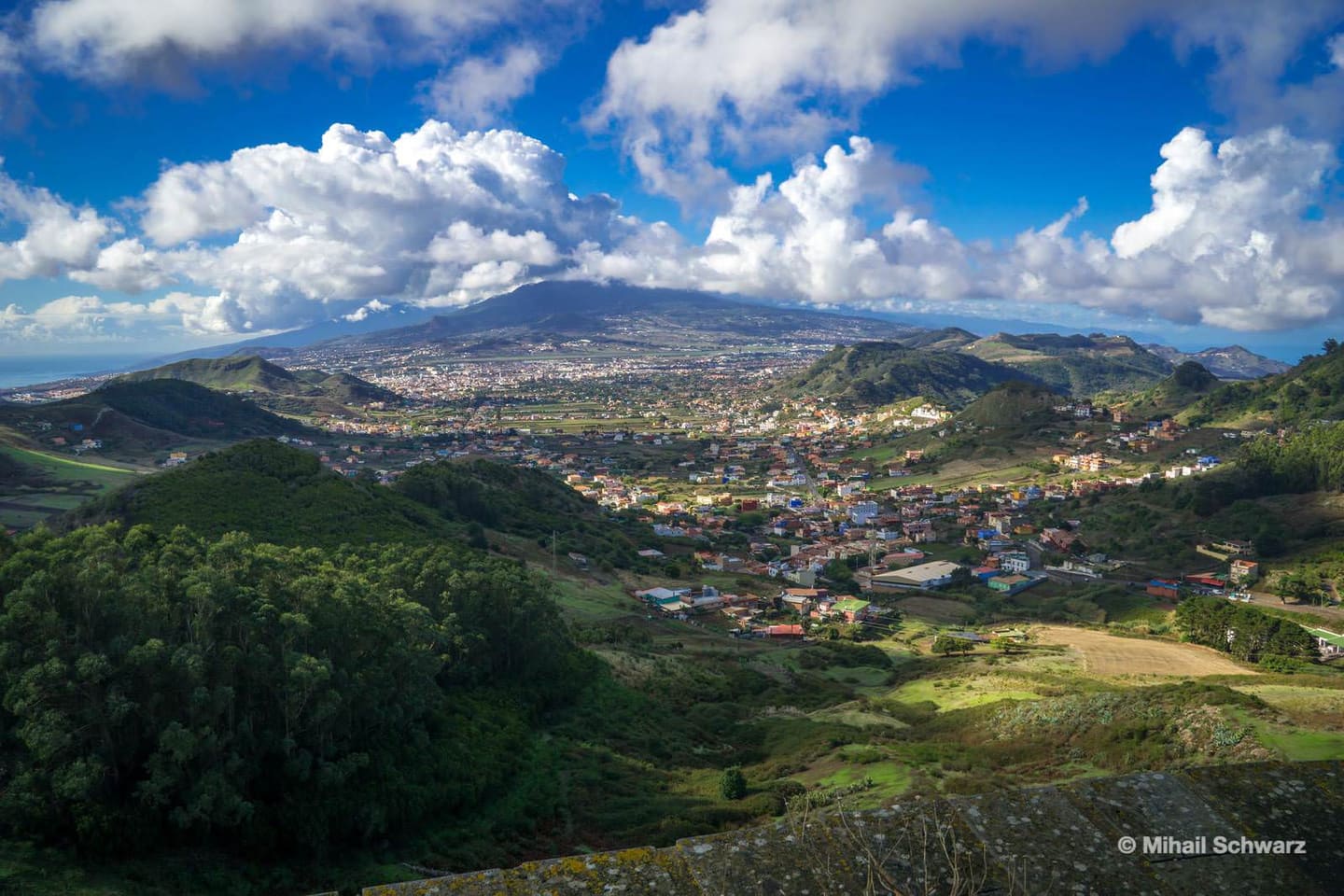
Check the forecast for La Laguna itself on the morning of your trip. The city and the Anaga mountains are also different stops: a dry old-town walk does not establish the conditions for a forest trail. If you combine the two, pack for the more demanding part of the day and choose your walking plan accordingly.
A comparison helps when choosing one cultural stop:
| Place | Choose it for | Main trade-off | Practical approach |
|---|---|---|---|
| La Laguna | A UNESCO old-town circuit, patios and museums | Cooler conditions; no beach within the historic centre | Walk, with tram access from Santa Cruz |
| La Orotava | Historic houses and a different northern-town setting | Sloping streets require more effort | Read the La Orotava guide before choosing your route |
| Santa Cruz | A larger coastal city, shopping and urban culture | More traffic and a less compact heritage circuit | Combine a city stop with the tram to La Laguna |
Choose one town properly if your available time is short. Collecting all three in a hurried circuit usually means sacrificing the interior visits and relaxed meal that make the cultural day worthwhile.
Tram Line 1 from Santa Cruz and other transport choices
Tranvía de Tenerife Line 1 links Santa Cruz and La Laguna, running between Intercambiador and La Trinidad. La Trinidad is the useful terminus for walking into the historic centre. Allow additional walking time from the stop rather than describing the tram as dropping you directly outside every landmark.
Check Metrotenerife’s current routes and schedules before travelling. The operator publishes different patterns for weekdays, weekends, public holidays and seasonal periods. Published end-to-end timetables show journeys around 35 minutes, but your boarding stop and service matter. Use the stop-to-stop timetable and add waiting and walking time to the journey you actually plan.
From the southern resorts, the tram is only the final stage of a longer public-transport journey. Compare your bus connection and return departure using the Tenerife bus guide and the operator’s current timetable. Don’t mistake a short metropolitan tram ride for the total travel time from Costa Adeje or Los Cristianos.
A car gives more flexibility for Anaga, but adds parking to an otherwise easy walking visit. Choose a lawful parking location outside the pedestrian core and finish on foot. If mountain roads are not appealing, an organised excursion can combine the city and landscape without asking you to navigate both.
Cultural tours
Choose a guided old-town walk if you want the planning history and house details explained. Confirm the meeting point, language, duration and any included entrances before paying. Compare cultural options in the Tenerife day-trip guide.
Anaga and La Laguna
Choose a combined outing for architecture and mountain scenery. Check how much time you actually get in town and whether the Anaga stop is a viewpoint or a walk. Start with the Anaga guide to decide what fits your fitness and interests.
Car hire
Consider a car for a wider island route rather than this town alone. Compare the complete rental cost, excess, fuel terms and collection point, then allow for parking. Use the Tenerife car-hire guide to decide which days need independent transport.
La Laguna questions before you go
Is La Laguna worth a full day?
Yes, if you want a museum, a cathedral visit and a slow lunch as well as the streets. For an outdoor circuit and coffee, a half-day is a more useful planning allowance. Travel from the south adds substantial time either way.
Can you visit without a guide?
Yes. The two main walking streets and Plaza del Adelantado make a straightforward independent route. A guide adds interpretation, particularly for the urban plan and architectural details, rather than making access possible.
Is La Laguna the same place as Santa Cruz?
No. They are neighbouring cities connected by the tram. La Laguna’s historic centre is inland and higher up; Santa Cruz is the coastal capital. Check the exact city and neighbourhood when booking a hotel or arranging a meeting point.
Can you combine the town with Anaga in one day?
Yes, but choose a limited plan: a city walk plus selected mountain stops, or a longer hike with a shorter town visit. Leave a weather-dependent buffer and check the return transport before setting off. A substantial hike and several museum visits need separate days.
Sources for planning your visit
Use UNESCO for the heritage context, the cathedral and Casa Lercaro museum for venue information, and Metrotenerife for your travel day. These sources were checked on 30 September 2026; recheck access and transport before setting off.