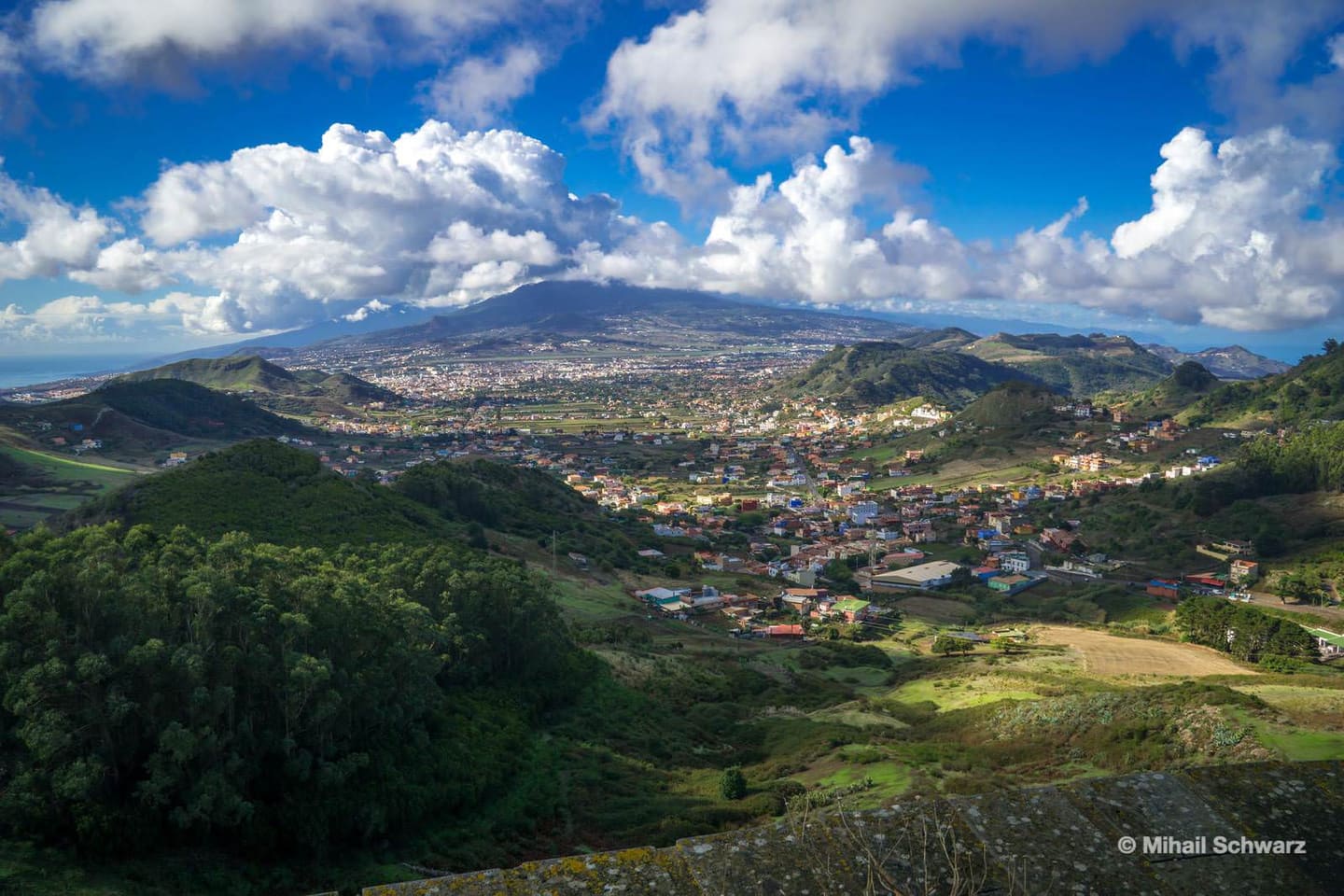

Icod de los Vinos is worth a half-day for the Drago Milenario, a walk through the old centre and a wine tasting. I’d choose it for a slower north-coast outing, especially alongside Garachico. You can see the dragon tree free from the square; paying for Parque del Drago buys a garden visit rather than the only view.
By Mihail Schwarz. Visitor information checked on 30 September 2026.
The Drago Milenario: an ancient tree, not a precise birthday
The Drago Milenario Tenerife visitors come to see is a huge specimen of Dracaena draco. Its thick trunk supports a branching crown of spiky leaf rosettes, giving it a shape quite unlike an ordinary broadleaf tree. It is the reason many people first hear of Icod, but the name needs a little explanation.
The municipal heritage record gives its height as approximately 21 metres and records its designation as a National Monument in 1917. Those are useful facts for understanding its scale and importance. Keep your distance and use the permitted paths: this is a protected living plant, not something to climb for a photograph.
Is it really the thousand year old dragon tree? That is its familiar name, not an established birth date. The council attributes roughly 1,000 years to it, while Tenerife Tourism’s botanical description attributes more than 800. I’d describe it as an ancient dragon tree whose exact age remains uncertain, rather than turn a competing estimate into a scientific certainty.
Its red resin, traditionally called dragon’s blood, helps explain the stories attached to it. Tenerife Tourism records historical uses in dyes and medicinal preparations. That history is not a reason to take resin or damage the bark; the useful thing to notice is how a plant became part of the island’s cultural identity.
The council also recounts a legend in which four surviving Guanche rulers met beneath the tree to discuss peace with the Spanish crown. Another connects dragon trees with the mythical guardian of the Garden of the Hesperides. These are traditions to read as traditions, rather than evidence proving a particular meeting or the tree’s age.
For me, the worthwhile question is what you want from the visit. If you enjoy plants, allow time to examine the garden’s other species as well as the famous specimen. If you’re mainly curious about the silhouette, start at the public viewpoint. Either choice gives you the context without requiring belief in every story on a souvenir label.
Parque del Drago or the free view from Plaza de San Marcos?
The viewing area beside San Marcos church is the simplest starting point. The square is commonly associated with the church’s name; on maps, look for Plaza de Andrés de Lorenzo Cáceres. The council’s square description confirms the perspective of the dragon tree opposite it.
You can appreciate the broad crown from this public space without buying a park ticket. I’d try this first if Icod is one stop on a long circuit. It also helps you decide whether a closer botanical visit matters to you, rather than paying simply because other people are entering.
Parque del Drago adds garden paths and a different relationship to the tree’s scale. Stay within the protected visitor areas; buying admission doesn’t mean unrestricted access to the trunk or roots. Think of the ticket as time in a botanical setting, not permission to stand anywhere beneath the canopy.
| Choice | Cost and time planning | What it gives you | Who I’d choose it for |
|---|---|---|---|
| Public square viewpoint | Free; allow 15–30 minutes | An overall view of the tree, beside the church | A brief stop or a tighter budget |
| Parque del Drago | Published non-resident adult tariff €5; allow 45–60 minutes | Garden paths and closer permitted viewpoints | Plant lovers and a less hurried visit |
These times are my itinerary allowances, not official visit lengths. The municipal operator’s published tariff lists non-resident adult admission at €5; confirm your category and the final price when booking. Reduced rates have their own eligibility rules, so don’t apply the adult figure to the whole family automatically.
Check the park’s seasonal hours shortly before travelling, especially around the change from September to October. Leave enough time before closing to enjoy the paths. For wheelchair access or a pushchair, ask about the actual route and surfaces before purchasing: a view from the square and a circuit inside the garden are different access questions.
Mariposario del Drago: butterflies instead of another viewpoint
Mariposario del Drago is beside the dragon-tree area, so it fits naturally into a town visit without a second cross-island journey. It is a tropical butterfly house where insects fly freely, rather than a display of pinned specimens. For children interested in living creatures, this can be the more engaging paid stop.
The operator describes more than 800 exotic butterflies from around the world and opportunities to learn about emergence and reproduction. That figure describes the attraction’s collection, not a promise that you will count 800 insects in flight at once. Slow down and look at plants and feeding areas as well as the butterflies overhead.
I’d allow around 45 minutes, with extra time if your children enjoy observing small details. Don’t build the visit around getting a butterfly to land on someone. Watch without chasing or handling them, follow staff instructions and check clothing before leaving the enclosure. A quiet pause is more useful than rushing through for one photograph.
On the checked information and prices page, adult entry is €11, with €8 for children aged 3–12 and a €9 concession category. The main website lists normal daily opening from 10:00 to 19:30, with separate Christmas and New Year arrangements. Recheck both pages for your date rather than assuming a tour’s stop time matches admission hours.
The operator states that the attraction is accessible to people with disabilities. If you need a specific arrangement, contact it about your requirements, including the approach from your parking place. For families with little time, I’d choose between butterflies and a longer garden visit, then leave room for lunch. Paying for both while watching the clock is rarely the most enjoyable version of Icod.
Icod wine tasting: Malvasía, bodegas and a proper pause
The town’s name makes wine part of the visit, rather than an unrelated souvenir stop. Icod sits in Tenerife’s wine landscape, and its historic centre offers a convenient way to explore that connection without organising a full vineyard excursion. A tasting works particularly well when someone else is driving or you’re travelling by bus.
Tenerife Tourism’s wine history traces exports from the north of the island to Europe by the sixteenth century. Britain’s market mattered to that trade, and Garachico was a departure port before the 1706 eruption changed its role. Read the Garachico guide if you’re combining the two towns: the wine story links them as well as the road does.
Malvasía wine is the name to ask about, but don’t assume every bottle is an amber dessert wine. Ask whether the wine is dry, semi-sweet or sweet, what grape variety it uses and where it was made. A volcanic landscape gives the tasting geographical context; it does not mean all local wines taste alike.
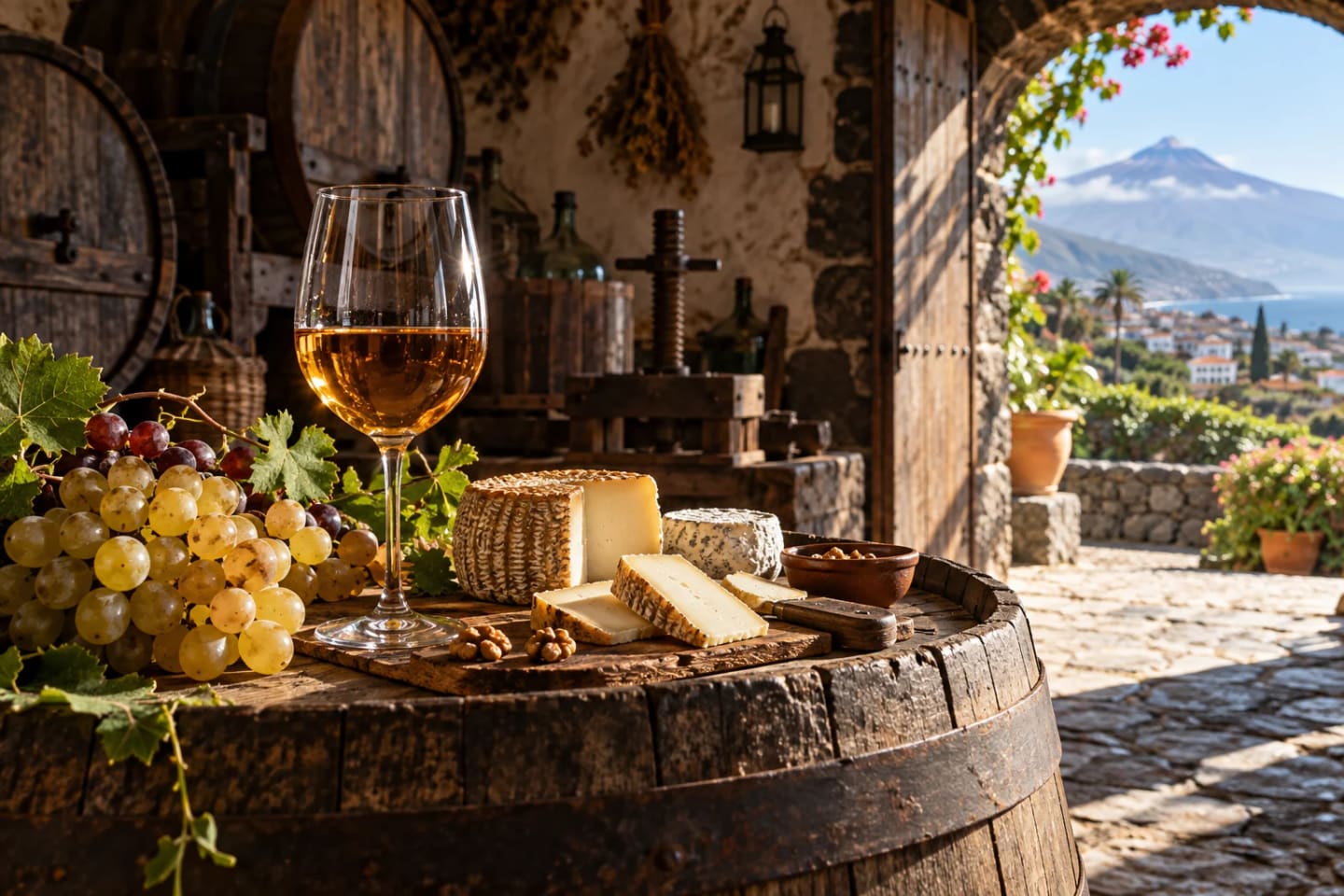
A specific option is Museo de Malvasía, Plaza de la Pila 5. Tenerife Tourism describes wine production, sales and tastings, including aromatic Malvasía. The name “museum” shouldn’t make you expect a large independent exhibition that takes several hours; choose it for the wine explanation and tasting format.
The venue’s website lists Cata Express from €12.90, Cata Histórica from €15.90 and Cata Premium from €24.90, checked on 30 September 2026. Its published hours are Tuesday–Saturday, 11:00–17:00, with Sunday and Monday closed. Contact it before building your day around a tasting, particularly for a group or a particular language.
Ask what each experience includes: number of wines, portion sizes, duration and any food pairing. If goat cheese matters to you, confirm it is included rather than treating an attractive image as the menu. Mention allergies and dietary requirements before booking. A tasting price is not automatically the price of lunch.
I’d choose one explained tasting over several hurried shop samples. It gives you a better basis for choosing a bottle and leaves time to enjoy the square. For a vineyard visit outside town, arrange transport and an appointment separately; a town-centre tasting room is not proof that the winery’s working vineyards accept walk-ins. Drivers should keep their visit alcohol-free.
The old town: San Marcos, Plaza de la Pila and San Agustín
The things to do in Icod don’t end at the park entrance. An easy sightseeing sequence starts around the church and dragon-tree viewpoint, continues towards Plaza de la Pila, then explores the San Agustín area. I’d leave at least an hour for the streets and squares, apart from paid attractions or a tasting.
San Marcos church is the main religious landmark beside the square. Its municipal heritage page describes the silver filigree cross associated with the church’s collection, a large work made in Havana in the seventeenth century. Check visitor access locally before expecting to see it: an open square doesn’t guarantee that the church or collection is open too.
Use the trees and benches around the square for a break, then walk on instead of spending the whole visit looking across one wall. The church exterior and neighbouring streets give the dragon tree a setting: it belongs beside an established town, not in an isolated wilderness park.
Plaza de la Pila, officially Plaza de la Constitución, is a separate square. Its familiar name comes from the central fountain, installed in 1716, according to the council’s account. This is the fountain stop to add to your walk; don’t confuse it with the dragon-tree viewing terrace.
Continue towards San Agustín church and the town-hall area. The municipality’s history traces the Augustinian convent to 1585 but explains that the convent itself has disappeared. The church survives; the former complex was altered for the present town hall and Plaza Luis León Huerta. Expect a surviving church, not an intact monastery tour.
Icod’s streets follow sloping ground, and short distances on a map can involve climbing. Wear shoes you can walk in, allow breaks and ask about individual entrances if steps are a problem. I’d take the centre at walking pace and keep museums optional, rather than turn a pleasant circuit into a hunt for every listed doorway.
Getting to Icod and combining Cueva del Viento
From Puerto de la Cruz, the usual road approach follows the northern TF-5 connections towards Icod. Follow current navigation to a signed public car park, then explore the centre on foot. Check prices, opening hours and payment arrangements at the car park itself; don’t drive into narrow historic streets in search of an assumed free space.
Without a car, TITSA 363 links Puerto de la Cruz with Icod and continues through Garachico towards Buenavista. The official timetable provides day-specific departures and passing times. Check the return service as well as the outward journey, and leave walking time between Icod station and the attractions.
Cueva del Viento is a separate uphill outing, not an entrance beside the tree. The cave operator requires advance online booking; guided times and languages appear in the booking system. Children under five cannot participate. Read our Cueva del Viento guide and the operator’s equipment and participation requirements before choosing this combination.
I’d book the cave first, then fit the town around its fixed appointment. Arrange transport to the visitor centre at Los Piquetes 51, allowing time for parking and check-in. Don’t assume arriving at Icod bus station leaves you ready for the cave tour. If you add Garachico too, shorten the town visit or leave the butterflies for another day.
For a week-long trip, the seven-day Tenerife itinerary helps put this northern outing in context. Keep one fixed booking and a flexible lunch, rather than scheduling every stop to the minute.
Choose your Icod day-trip format
North-coast circuit
Choose a guided circuit if you want Icod and Garachico without driving. Compare pickup points, total duration, Icod free time, entry inclusions and cancellation terms.
Compare Tenerife day tripsCueva del Viento tour
Choose this for a guided lava-tube experience. Book the correct language and time, check eligibility and equipment, and confirm whether any transport is included.
Plan your cave visitHire a car
Choose independent transport for flexible town stops. Compare total price, deposit, insurance excess, fuel policy and cancellation terms; nominate a non-drinking driver.
Decide whether to hire a carSources and checks before travelling
Municipal heritage records, Tenerife Tourism, TITSA and the attraction operators linked above support the factual details. Prices and opening information were checked on 30 September 2026; confirm them before booking. My suggested time allowances are planning advice. For a short visit, start with the free tree view and the squares; for a half-day, add the paid attraction that interests you most.