
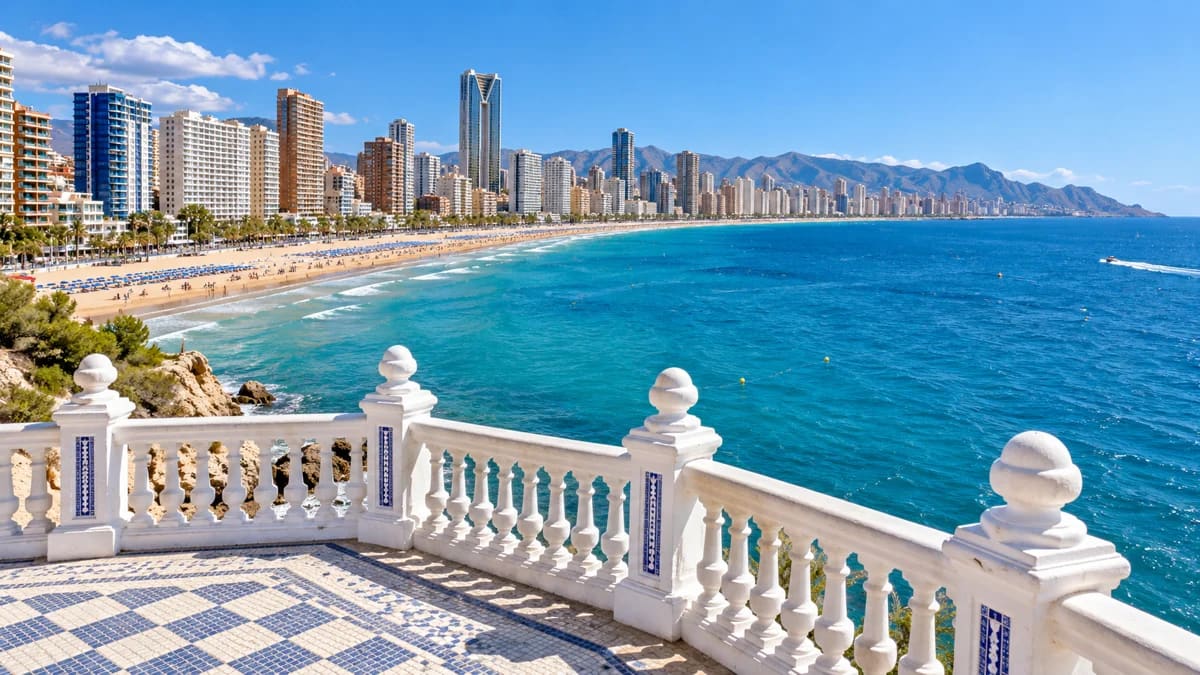
The Mediterranean Balcony and Levante skyline.
Benidorm is a practical Costa Blanca base for sandy beaches, late evenings and days out without changing hotels. This Benidorm Spain guide starts with the decision that matters most: choose Levante for a busy resort atmosphere, Poniente for more beach space, or the Old Town for tapas and walks between the two. I’d start with the Old Town for a first visit, then choose your hotel according to how much nightlife you want outside the door.
Benidorm’s two faces: skyline and Old Town
Benidorm’s towers are part of its character, rather than an unfortunate background to the beach. Hotels and apartment blocks rise behind the sand, while the Mediterranean remains the main attraction at street level. This is an urban seaside holiday: you can walk from a supermarket to a beach café, go swimming, then find dinner without organising a drive.
The contrast becomes clearer around the rocky headland occupied by the Old Town. Levante stretches east, Poniente west, and the historic streets sit between them. That geography is useful when choosing accommodation, but it doesn’t create a hard border between a British resort and a Spanish town. Spanish residents, international visitors and different types of businesses overlap across Benidorm.
Levante’s eastern resort streets suit people who want entertainment close by. If your holiday involves a show after dinner and another drink afterwards, staying nearby saves journeys home. The drawback is equally obvious: a room above a busy bar can be a poor bargain when you want an early night. Read recent reviews for the actual building, and look for comments about bedrooms facing the street.
Poniente spreads farther along the western waterfront. I’d choose it for a beach-led stay where evening walks matter more than finding the busiest bar. It still has restaurants and high-rise apartments; don’t book it expecting a secluded village. Distance along this long beach also matters. A waterfront address at its far end is a different base from one beside the Old Town.
For a short break, the centre gives you the most flexibility. For a longer holiday, choose your daily routine first: sand and a pool, nightlife, or restaurants and exploring. Spring and autumn are useful times to consider for walking, but check the forecast and park calendars rather than assuming every attraction operates throughout the year. Summer brings heat and busy beaches; winter suits promenade walks better than a guaranteed swimming holiday.
Levante vs Poniente: which beach suits you?
Both main beaches have golden sand, seafront promenades and services close at hand. The difference is how you want to spend the hours around swimming. Playa de Levante Benidorm is the busier resort choice; Playa de Poniente gives you a longer stretch to explore and more scope to move away from the central bustle.
| Base | Best for | Main compromise | Before booking |
|---|---|---|---|
| Levante | Beach cafés, entertainment and short walks back to busy resort streets | Crowds and potential evening noise | Check the room’s orientation and nearby bars |
| Poniente | Longer beach walks and a more relaxed beach-led stay | Far-west hotels mean longer journeys to central nightlife | Measure the walk to the Old Town, not just to the sand |
| Old Town | Tapas, short breaks and access to both waterfronts | Narrow streets, slopes and fewer large resort-style pools | Check luggage access, stairs and taxi drop-off |
Playa de Levante: convenience with company
Levante runs for roughly two kilometres, backed by a promenade and dense resort streets. Choose it when you want lunch, drinks and your hotel within an easy walk. The convenience is particularly useful if members of your group want different things: one can stay on the sand while another heads back for a break.
Don’t expect empty sand around the busiest central sections in high season. Arrive earlier for a family beach session, and keep a simple landmark in mind when you leave the water; rows of parasols can make your belongings surprisingly hard to spot. A beach bag with only what you need is easier to manage than bringing the whole day’s luggage.
Playa de Poniente: room for a longer day
Poniente extends for more than three kilometres west from the harbour area. Its length is the advantage: you can combine a swim with a substantial waterfront walk, or choose a section close to your accommodation rather than travelling to a famous central spot. I would favour it for a mixed-age group that wants an unhurried day and dinner nearby.
The harbour and its breakwater help explain the layout beside the Old Town, but neither main beach is an enclosed swimming pool. Check beach flags and follow lifeguard instructions. Clear water and a gentle-looking shoreline don’t establish the conditions farther out, particularly when wind or swell changes during the day.
Families, loungers and accessible bathing
Sunbeds and parasols are paid extras where concessions operate. Check the displayed daily charge and what’s included before settling down; bringing your own towel keeps the beach day cheaper. For children, shade, drinks and easy access to toilets matter more than choosing the supposedly best beach. Keep the hottest part of the day for a meal or indoor break.
Benidorm provides accessible bathing points, including one by Calle Murcia on Levante and points near Parque de Elche and the La Cala end of Poniente. Confirm operating hours and assistance arrangements with the municipal service before travelling. A flat promenade doesn’t mean every route across sand is accessible, and assisted sea access depends on the service and conditions that day.
Benidorm Old Town and the Balcón del Mediterráneo
Benidorm Old Town is the easiest place to change pace without leaving the resort. Streets narrow, buildings sit closer together, and the waterfront opens out around the headland. I’d explore here before deciding the whole town is defined by its towers: the historic centre gives a better sense of why the beaches grew around this particular point.
Head towards Plaza del Castillo and the church of San Jaime and Santa Ana. The Balcón del Mediterráneo occupies the former castle area, with white balustrades, blue-and-white details and views along the coast. It is a viewpoint rather than a lengthy attraction, so give it time for a pause instead of building half a day around it.
The upper square and the lower viewing terrace are different access propositions. Steps lead down towards the sea-facing balcony; anyone avoiding stairs should check the route and enjoy the views available from the upper area. Don’t assume a photograph of the lower terrace proves that the entire viewpoint is step-free.
Below the headland, Playa del Mal Pas offers a much smaller sandy alternative beside the harbour. It is useful for understanding the town’s geography, but limited space means it isn’t automatically the quiet option. For a full beach day with children and equipment, the larger beaches are usually the simpler choice.
A first-day route needs very little planning: walk one promenade towards the centre, explore the church and castle square, then come down into the restaurant streets. Add the other waterfront if you still have energy. Comfortable shoes help on polished paving and slopes; flip-flops that work on sand are less useful for a long town walk.
Benidorm theme parks: Terra Mítica or Aqualandia?
Benidorm theme parks work best as separate days, especially with children. Terra Mítica is the choice for themed rides and shows; Aqualandia is the choice for water slides and swimming attractions. I’d choose according to the least enthusiastic person in your group, because a ticket is poor value if they spend the day waiting beside rides they cannot or don’t want to use.
Terra Mítica Benidorm: rides with ancient-world scenery
Terra Mítica uses settings inspired by ancient Mediterranean civilisations, including Egypt, Greece and Rome. Think ride-led entertainment rather than an archaeological introduction. Before buying, look at the current attraction list and height restrictions together: a younger child may find the scenery appealing but qualify for far fewer rides than an older sibling.
Check the operating calendar for your exact date. Seasonal opening, shows and individual attractions can change, and a park advertised online is not a promise that every ride will run. Decide whether a day’s visit fits your schedule before comparing tickets. A cheaper ticket for an unusable date is no saving.
Aqualandia: a water-park day needs its own plan
Aqualandia combines water attractions of different intensities, including fast slides. Height and other ride restrictions matter here too. Look up the rules before promising a particular slide, and check whether glasses, footwear or loose belongings need to be removed. Arrange a meeting point if your group splits up.
A water park also needs more preparation than an ordinary beach stop. Bring suitable swimwear, sun protection and a way to secure valuables. Check the current food, locker and extra-charge policies before packing; the admission ticket may not cover everything you use inside. Keep time for rests instead of treating every queue as another challenge to complete.
For either park, compare the official ticket options first, then any reputable seller offering a discount. Check the date, included areas, age categories and cancellation terms rather than comparing the headline price alone. Don’t assume free cancellation, hotel pickup or a combined ticket. Arrange the outward and return journey before buying, particularly if you expect a tired child at closing time.
Tapas Alley: an evening around Calle Santo Domingo
Calle Santo Domingo and nearby Old Town streets are a useful starting point for tapas. The appeal is the concentration of bars: you can try a small plate, move a short distance, then decide whether to settle somewhere for dinner. I’d start with one or two dishes rather than order a full spread in the first place you enter.

A pincho is commonly a small bite, often served on bread or held together with a cocktail stick; Basque-style versions are part of the area’s food offer. A tapa may be a small cooked dish, while a ración is a larger portion intended for sharing. Ask about portion size before ordering, especially if your group wants to taste several things.
Prawns, cured ham, tortilla and other small plates are straightforward choices to look for on menus, but availability and preparation vary by bar. Don’t infer freshness from a coastal address. Ask what has been prepared that day and check the price of seafood sold by weight before agreeing to an order.
Old Town evenings can be lively as well as Levante’s entertainment streets. The quieter choice is a room away from bar entrances, rather than simply an Old Town postcode. For a beach-and-tapas break, I’d prioritise a comfortable room within walking distance, then leave the evening flexible enough to follow the menus that appeal to you.
Getting to Benidorm: Alicante Airport, buses and TRAM
Alicante–Elche Miguel Hernández Airport (ALC) is the main arrival point for many Benidorm holidays. Compare an airport coach with a prebooked transfer before hiring a car for the whole stay. If your plans mostly involve the main beaches and Old Town, parking and rental costs can buy very little extra freedom.
The airport coach and transfers
ALSA sells airport connections to Benidorm. Use its live journey search for your arrival date, departure time, fare and actual stop. Leave room for baggage collection rather than booking against the aircraft’s scheduled landing time. Check the final journey from the coach stop to your accommodation too; a direct airport service doesn’t necessarily drop you outside the hotel.
A private transfer can make more sense for a late arrival, a group with substantial luggage or someone who needs direct access. Confirm the vehicle size, child-seat arrangements, waiting allowance and late-flight policy in writing. Compare the total for the whole group with coach tickets plus the final taxi ride.
TRAM from Alicante and along the coast
TRAM d’Alacant Line 1 connects Alicante’s Luceros area with Benidorm. It is a coastal travel option from the city, not a direct railway from the airport terminal. If you’re arriving by air, reaching Alicante first adds another connection; I would usually compare the direct airport coach before choosing that route with luggage.
Line 9 serves the coast beyond Benidorm, including Altea and Calp. Consult the official journey planner and service notices for connections and any replacement transport. Stations are not interchangeable with beachfront addresses: allow time at both ends, and check the return service before spending the evening in another town.
Altea, Guadalest and Calp as separate days
Altea suits a slower outing with a waterfront walk and a climb into its old centre. Guadalest offers an inland change of scenery, but isn’t reached by the coastal TRAM; organise a car, tour or suitable bus connection separately. Check what an excursion includes, especially museum admissions and free time.
For another coastal town, use our Calp guide to decide whether its beaches and rock scenery deserve a separate day. The Alicante guide is useful if you want a city visit before or after Benidorm. I’d choose one outing per day instead of turning a beach holiday into a sequence of hurried stops.
Three bookings to compare before you commit
Terra Mítica tickets
For a ride-led day. Check the dated calendar, height restrictions, included areas and cancellation policy; transport is separate unless stated.
Check official ticket optionsAlicante Airport coach
For a public-transport arrival. Compare the live fare, departure time, luggage allowance and Benidorm stop with your hotel's location.
Search airport departuresA day trip to Guadalest
For an inland day away from the beach. Compare pickup location, total duration, admissions and return time before selecting a tour.
Plan your Guadalest visitQuestions before your first stay
Is Benidorm only for nightlife?
No. The beaches, Old Town and nearby excursions support a daytime holiday too. Choose your hotel’s immediate surroundings carefully, because the wrong street can affect sleep more than the resort’s overall reputation.
Do you need a car in Benidorm?
Usually not for a stay centred on the main beaches and central streets. A car becomes more useful for independent inland trips. Compare a day’s hire or organised excursion with paying to park throughout the holiday.
Can you visit the beach and a theme park in one day?
You can, but I’d avoid buying a full-day park ticket for a hurried visit. Give the park its own day and leave a promenade walk or short swim for another morning.
Sources checked
Transport and park information checked on 30 September 2026. Recheck dated fares, calendars and service notices before paying.
- Spain’s official tourism guide to Benidorm for town geography and beach context.
- Benidorm accessible beach information for assisted bathing locations.
- Comunitat Valenciana’s Benidorm map for the Old Town tapas streets.
- Terra Mítica and Aqualandia for current park information and booking checks.
- ALSA airport connections and TRAM d’Alacant for transport planning.