Scuba diving in Tenerife works for three quite different travellers: complete beginners booking a supervised try dive, qualified divers choosing guided shore or boat dives, and students taking a PADI or SSI course. Pick the category first. A cheap guided dive is no use to a beginner if it requires a certification card, and a try dive will feel restrictive to an experienced diver.
Written by Mihail Schwarz; editorially reviewed by TouchDownSouth. Safety guidance and advertised prices were checked on 12 September 2026 against DAN, PADI and direct dive-centre pages. Prices, sea conditions, insurance and medical requirements can change; confirm them with the centre before paying.
Which type of Tenerife dive should you book?
Try dive or Discover Scuba Diving
Choose this if you have no scuba qualification. A professional gives you a briefing, checks basic skills in shallow water and supervises the dive. Ocean Trek currently distinguishes its €90 try dive from a €120 PADI Discover Scuba Diving session that includes more theory, skills and PADI registration; both list roughly 45 minutes underwater and a maximum depth of 12 metres.
This is the sensible holiday test. It is not a shortcut to independent diving, and you should not book it if you cannot complete the medical screening honestly.
Guided dives for certified divers
Choose this if you already hold a recognised certification and want a local guide, tanks and weights, with equipment hire where needed. The centre will normally ask about your qualification, number of logged dives and last dive before it chooses a suitable site. Bring the card and log details rather than assuming a boat place guarantees access to every route.
PADI or SSI courses
Choose a full entry-level course if you want a reusable qualification, not just one underwater experience. Course prices cover substantially more training than a try dive. La Escafandra in Las Eras listed its Open Water course at €370 when checked; compare what the fee includes, how confined-water training is handled and whether learning materials, certification, insurance and equipment are all in the quoted total.
Compare current diving options
The figures below are direct advertised prices checked on 12 September 2026. They are snapshots, not guarantees for your date.
| Option | Price from | Time | Base | Who it suits | Published inclusions |
|---|---|---|---|---|---|
| La Escafandra try dive | €60 | Confirm | Las Eras | Complete beginners | Full equipment hire |
| Sa Caleta try dive | €70 | Confirm | Los Cristianos | Complete beginners | Ask centre to confirm current package |
| Ocean Trek try dive | €90 | About 3 hrs | Torviscas | Complete beginners | Briefing, shallow-water skills, equipment and supervised dive |
| La Escafandra guided shore dive | €30 | Confirm | Las Eras | Certified divers | Guide; equipment priced separately unless stated |
| La Escafandra Open Water | €370 | Multi-session | Las Eras | New course students | Confirm materials, certification, insurance and equipment |
Low-cost first taste
From €60
La Escafandra · Las Eras · complete equipment advertised
Check availabilityStructured try dive
From €90
Ocean Trek · about three hours · briefing and shallow-water practice
Book onlineEntry-level qualification
From €370
La Escafandra · Open Water course · Las Eras
Check course datesDive sites: choose conditions, not a famous name
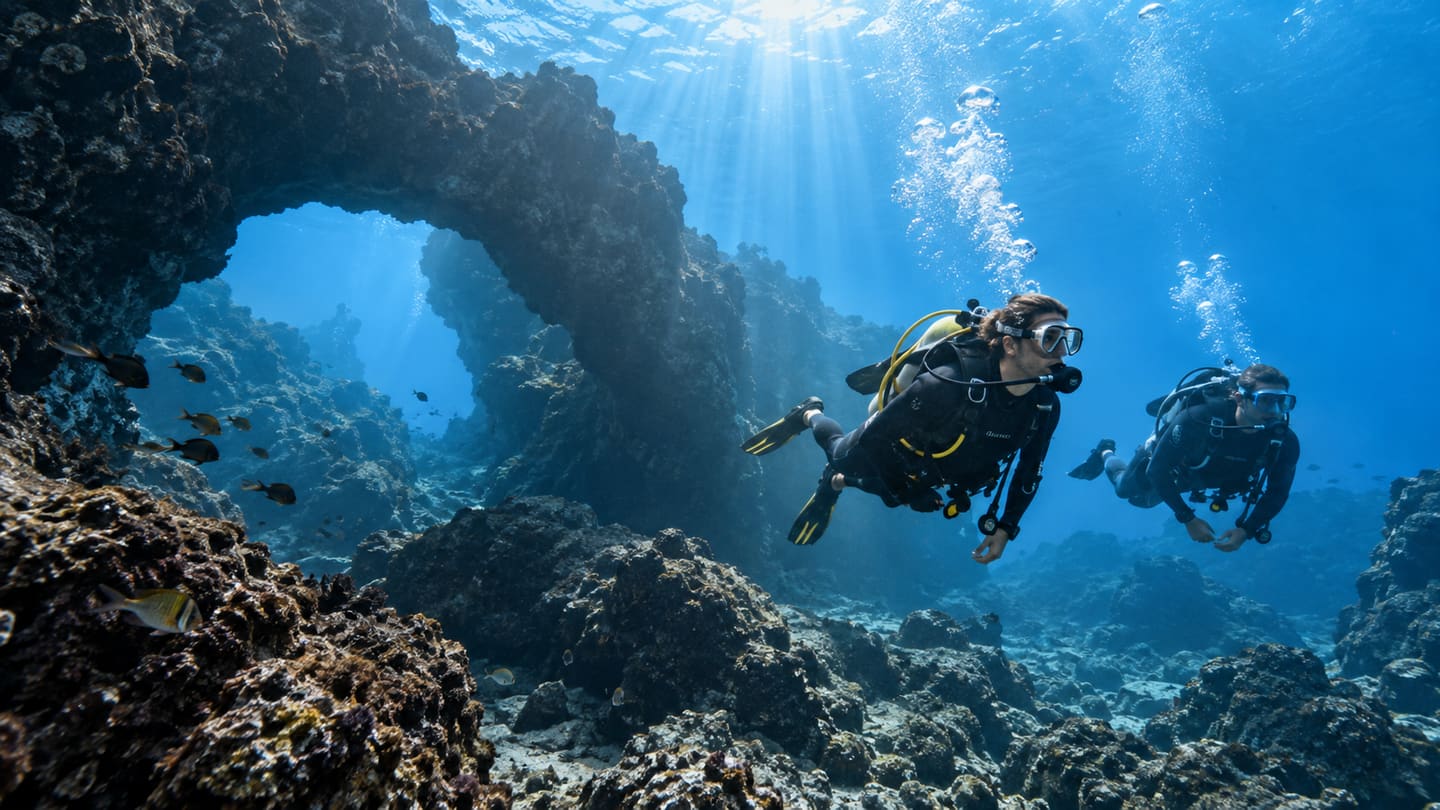
Tenerife’s volcanic coast creates rock reefs, walls, arches and swim-throughs rather than a tropical coral landscape. Radazul is associated with volcanic formations and training dives, while Las Eras offers shore access to reefs used by its local centre. South-coast operators may also plan dives around Los Cristianos, Las Galletas or sheltered sites selected on the day.
El Puertito is often sold with turtle language, but wildlife is never guaranteed. Treat any turtle, ray or shoal encounter as a possibility, not an entitlement. Never touch, chase or feed an animal, and follow the guide’s route even if something interesting appears beyond it.
Wrecks, caves and overhead swim-throughs need a more careful conversation. Your certification, recent experience, gas plan and the day’s conditions decide whether a site is appropriate. A recognised name on a sales page does not make it suitable for every diver.
Medical screening, insurance and the no-fly interval
PADI requires student divers to complete medical paperwork. A “yes” answer does not automatically ban you from diving, but it can mean that a doctor must assess you before the centre lets you take part. Do not hide medication, breathing, heart, ear, sinus, pregnancy or other relevant health information to save a day of your holiday.
Ask exactly what insurance the booking includes. Travel insurance does not always cover scuba, depth limits, treatment in a hyperbaric chamber or evacuation. Qualified divers should also check whether the centre expects their own diving insurance.
Do not combine scuba with a flight or a drive up Teide on the same schedule. DAN recommends at least 12 hours before flying after one no-decompression dive, at least 18 hours after multiple dives in a day or over several days, and substantially longer after a dive requiring decompression stops. Altitude after diving matters too: plan Teide for before your dive days or after the conservative interval advised by your dive professional.
If you have possible decompression-sickness symptoms, do not fly or drive uphill. Seek urgent specialist advice. The standard waiting periods reduce risk; they do not guarantee that decompression sickness cannot occur.
Equipment, logistics and cancellation
A beginner package should provide the scuba equipment and direct supervision. Certified-diver prices vary more: a low headline rate may cover only the guide, tank and weights, with a wetsuit, regulator, buoyancy device, computer or insurance charged separately. Ask for the complete payable total.
Water temperature, wind and visibility vary by season and coast. A centre may move or cancel the planned site, which is normally a sign that its safety process is working. Before paying, save the cancellation terms and ask what happens if the operator cancels, if the sea is unsuitable, or if medical clearance is not obtained in time.
For a broader look at jet skis, parasailing and other options, return to the Tenerife water sports comparison.
Frequently asked questions
Can I scuba dive in Tenerife without a licence?
Yes, but only in a supervised beginner programme such as a try dive or Discover Scuba Diving. It does not qualify you for independent diving. Complete the centre’s medical screening and follow the instructor’s depth and skills limits.
Is PADI better than SSI in Tenerife?
Both are widely recognised training systems. The more useful comparison is the individual centre: instructor communication, group size, transparent inclusions, equipment condition and a schedule that leaves enough time before flying.
How long should I wait before flying after scuba diving?
DAN’s minimum is 12 hours after a single no-decompression dive and 18 hours after repetitive or multi-day no-decompression diving. Decompression dives require a longer interval. A full 24-hour buffer is easier to plan and may be the more conservative holiday choice, but follow the advice for your actual dive profile.
Can I go up Mount Teide after diving?
Do not treat it as an ordinary same-day drive. Teide means substantial altitude exposure after diving. Put the mountain before the dive portion of your holiday, or ask a diving-medicine professional for advice based on the exact profile and interval.
Sources and final booking check
These primary and direct sources were checked on 12 September 2026:
- DAN flying-after-diving guidance
- PADI medical forms and screening guidance
- Ocean Trek try-dive programme and prices
- Sa Caleta 2026 diving rates and schedule
- La Escafandra prices for try dives, guided dives and courses
Confirm the final total, required certification, medical clearance, insurance, meeting time, cancellation terms and post-dive altitude plan directly with the centre. Those details matter more than picking the most photographed site.