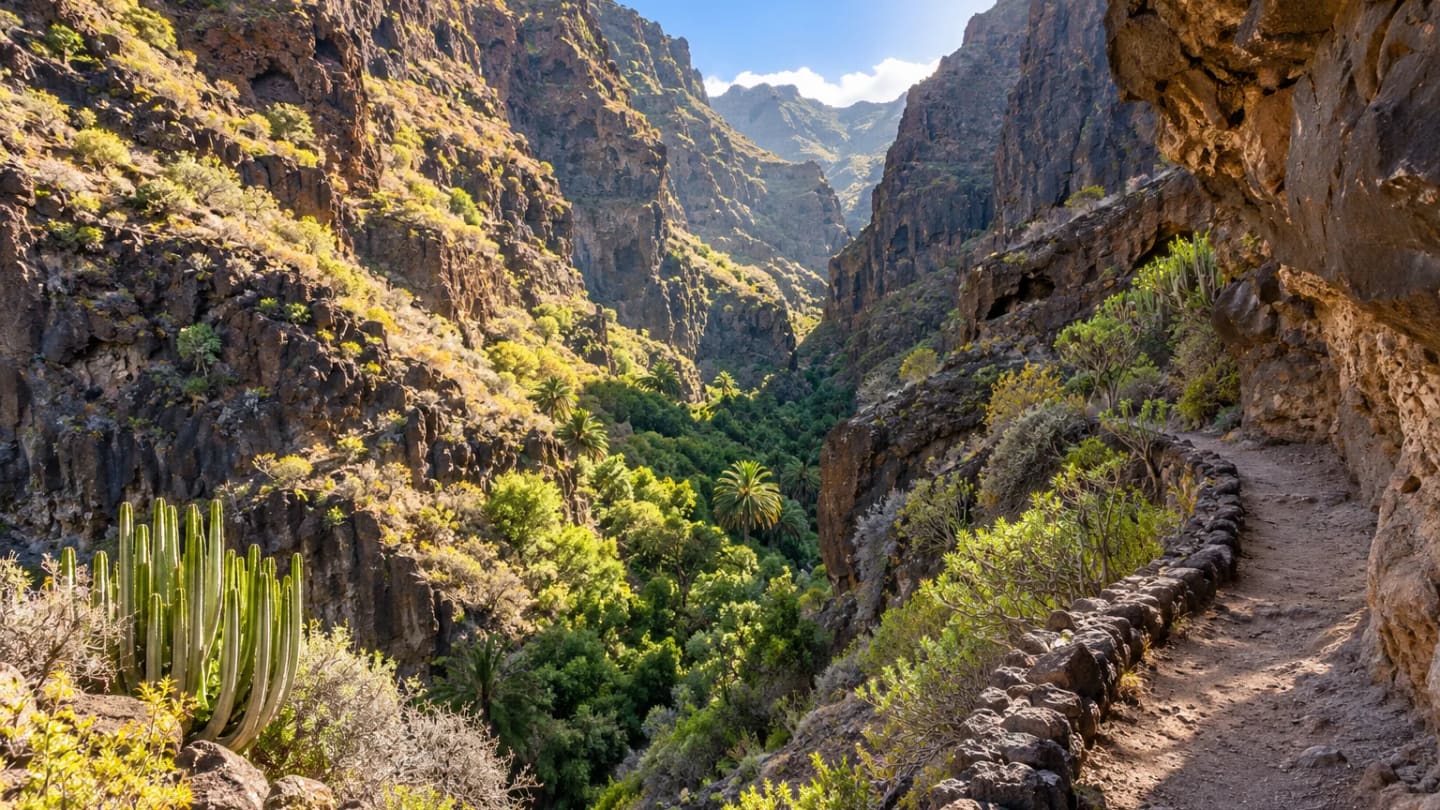
The volcanic gorge and cliffside trail of Barranco del Infierno.
Barranco del Infierno is a booked, 6.5 km return hike from Adeje into a protected volcanic gorge ending at a waterfall. Allow three to three and a half hours, wear closed walking shoes and keep the supplied helmet on. The operator currently lists a €15 adult non-resident ticket; reserve a morning slot before travelling.
Written and reviewed by Mihail Schwarz. Practical sources checked on 30 September 2026.
Why Hell’s Gorge is greener than the surrounding south
The name sounds forbidding: Barranco del Infierno translates as Hell’s Gorge. Its attraction is the change from exposed southern slopes to a narrower, greener watercourse. Deep walls shelter parts of the ravine, while springs support moisture-dependent habitats in a landscape where water has always mattered. This is a useful alternative to another beach morning when you want to understand the island beyond its resort strip.
The contrast is also why I’d choose this walk for someone staying in Costa Adeje. You can spend a morning in a different landscape without making the much longer journey to the northern forests. That recommendation depends on being comfortable with uneven ground and exposed sections. If those are a problem, a cultural visit to Adeje town is the better outing.
Water shaped human settlement here long before the tourism economy. The municipal water-route account records Guanche occupation close to ravine channels, where caves and water helped sustain communities. After the conquest, channels carried water towards lower farmland and the town. Agriculture, including sugar-cane production, depended on that supply rather than on the dry-looking slopes alone.
Look at the gorge with that history in mind. A water channel or mill has more meaning when you understand why moving freshwater was such a valuable undertaking. The trail follows part of an older working landscape; it was not created simply to give holidaymakers somewhere to walk. Archaeological caves belong to this history, but they are not an invitation to scramble away from the authorised path.
The 6.5 km Adeje canyon hike: time, ascent and difficulty
The distance is for the outward and return journey together. You follow the route into the gorge and come back along it; this is not a circular walk or a crossing to another village. Budget three to three and a half hours on the trail, then add check-in, the walk from your parking space and whatever time you want in Adeje afterwards.
Official descriptions disagree on the difficulty label. The operator calls it low to medium, while Tenerife Tourism uses medium to high and highlights the early section for people with vertigo. I’d treat it as a moderate countryside hike with exposure, rather than an easy urban stroll. Fitness helps, but your confidence on narrow paths matters just as much as your walking speed.
The entrance is around 350 metres above sea level. The operator describes the trail reaching roughly 600 metres; those are elevations, not a measured total of every climb along the way. Tourism information gives a different maximum height-difference figure. For planning, expect undulations and sustained walking on rocky ground rather than relying on one precise ascent number.
At first, the route offers broad views towards Adeje and the south. Farther in, the walls close around the watercourse and the setting becomes more enclosed. Avoid rushing the open section just because the waterfall is the advertised finish. If the exposure makes you uncomfortable, speak to staff and turn back within the permitted route rather than forcing yourself onwards.
Take closed shoes with a sole that grips stone and loose earth. The operator excludes sandals, including hiking sandals. Its packing advice suggests 1–1.5 litres of water per person; take conditions and your own needs into account rather than treating that as a maximum. Add a snack, sun protection and a small bag that leaves your hands free. Leave bulky luggage elsewhere, as the entrance has no suitcase storage.
The Barranco del Infierno waterfall: what to expect
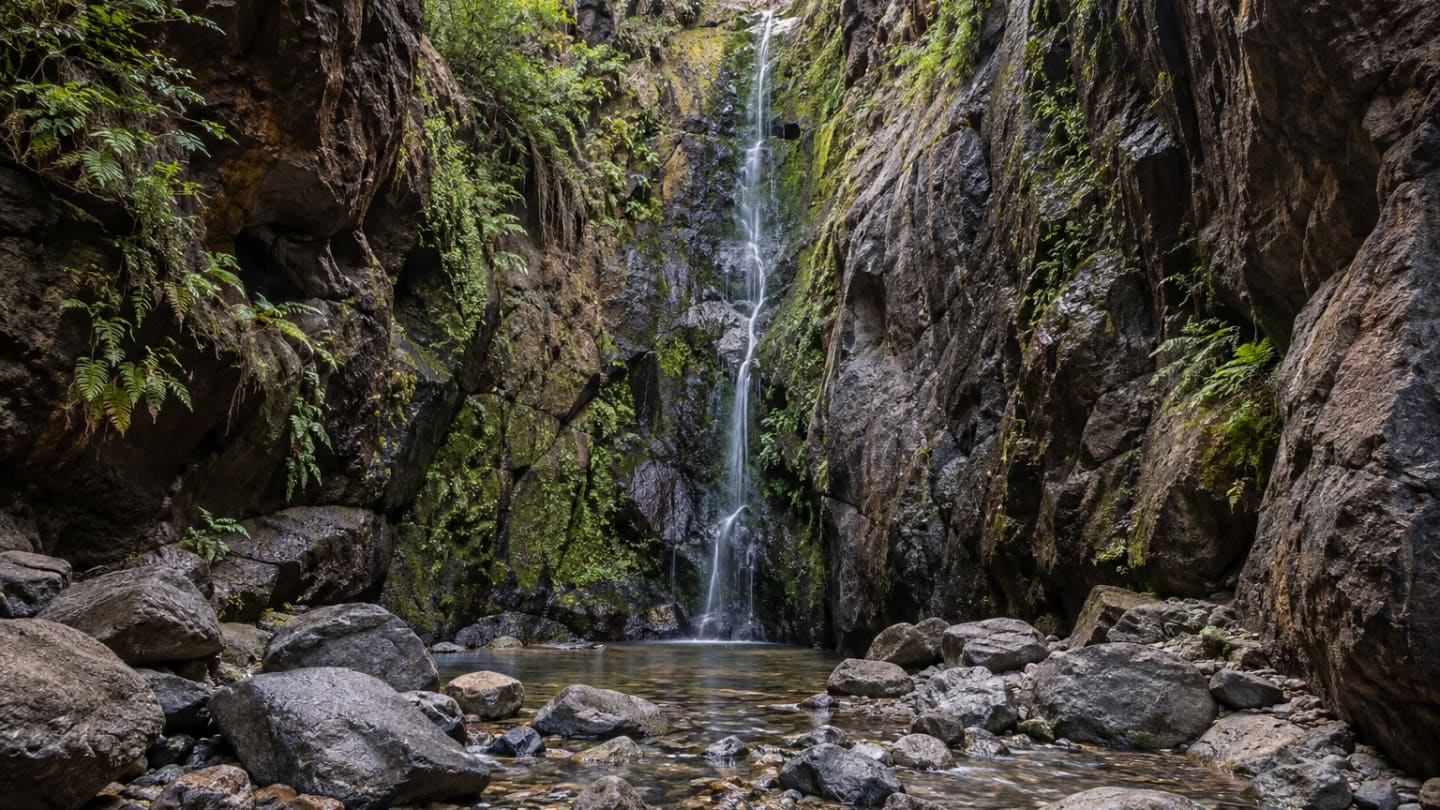
The waterfall is the turning point of the walk, framed by steep volcanic walls. Its appeal is the enclosed setting and the presence of freshwater in this dry part of Tenerife. Go expecting a natural watercourse whose appearance can change, rather than a guaranteed broad curtain of water matching the most dramatic photograph online.
I wouldn’t choose the excursion solely for waterfall photography. The gorge, changing vegetation and views make a more reliable reason to go. If a powerful cascade is essential to your plans, ask the operator about recent conditions before booking. Wet weather may increase water flow while also making access unsafe; it is not a reason to seek entry when the trail is closed.
Descriptions sometimes call this Tenerife’s only permanent waterfall. That absolute claim is unnecessary for planning and is not established by the sources checked here. The useful fact is that this authorised Adeje trail leads to a waterfall in a spring-fed ravine. No fixed flow, exact photographic appearance or island-wide uniqueness is promised.
Bathing is prohibited both in the gorge and at the waterfall under the official rules. Keep to the viewing area and follow staff instructions about where to stop or move on. A pool at the foot of a rock wall is not a swimming opportunity. Keep your helmet on for photographs too; the rule applies throughout the visit, not only while you are walking.
Barranco del Infierno tickets, permits and entry rules
Book through the official operator before travelling. Its current published standard adult non-resident price is €15, with €5 listed for Canary Islands residents who can provide the required proof. Check the booking form for your category and date, especially for children or guided products. Older guides quoting around €11 should not be used as the final price reference.
Barranco del Infierno permits are effectively the controlled booking for this visitor trail. You need the correct date and entry slot, not a general island hiking permission. A guided excursion and a standard trail ticket are different purchases: check whether a reseller includes admission and whether it actually visits this gorge rather than another walking route.
The widely published conservation cap is 300 visitors a day. The current trail page also specifies entry in groups of 20 per half-hour. Those figures describe different controls, so they do not mean you can turn up whenever you like because fewer than 300 people appear to be present. Your confirmed slot and the operator’s availability determine access.
Arrive 15 minutes before your start time, with booking confirmation accessible on your phone and the identification required for your ticket. Keep a copy available without depending on mobile reception. Access is in the morning, with seasonal schedules and possible changes during heat or unsafe weather. Use your booking instructions for the actual start time instead of relying on a copied opening-hours table.
The helmet is supplied and included in admission. Children under five cannot enter, including in baby carriers; the operator’s booking page and FAQ require children under 16 to be accompanied by an adult. Its general rules refer more broadly to minors, so I’d arrange adult accompaniment for anyone under 18. Pets are not allowed.
Cancellation wording deserves attention. The FAQ describes changes or refunds with at least 72 hours’ notice and separate arrangements when the operator closes the trail; the general rules contain stricter non-refund wording. Read the terms presented with your purchase and ask about any conflict before paying. On the day, check messages from the operator and respect closures for rain, wind or other safety concerns.
Flora, dragon trees and birds of prey
The reserve covers more than the visitor trail, with habitats changing across its elevations. Lower slopes support cardonal-tabaibal vegetation: cardón and tabaiba are characteristic plants of dry Canarian landscapes. Farther up, remnants of thermophilous woodland include wild jasmine, palms and dragon trees. These communities help explain why the canyon looks different as you move away from the entrance.
Canary Island pine belongs particularly to the higher parts of the reserve. Do not expect the entire booked walk to run through dense pine forest. The operator places pine woodland above roughly 600 metres, while the visitor path reaches around that elevation. If shaded woodland is your main aim, compare the routes in Anaga rather than choosing this gorge from a photograph of the wider reserve.
Roque del Conde is also associated with the protected reserve, but climbing it is a separate route. A Barranco del Infierno ticket does not turn the gorge walk into a summit itinerary. Keep those outings separate when assessing distance, transport and fitness; adding a mountain simply because it appears on the same regional map can change the demands substantially.
The municipality records kestrels, buzzards and sparrowhawks among the reserve’s birds of prey. A bird circling over a cliff adds interest, but a particular sighting is never guaranteed. Stop at a suitable wider place to look, without blocking other walkers or moving towards an edge. Binoculars are more useful than trying to approach nesting hollows.
Leave plants, stones and wildlife where they are. Feeding animals, collecting specimens and amplified sound are prohibited. I’d keep this a quiet outing: the smaller details are easier to notice when the walk is not accompanied by a speaker. Carry rubbish back out, including food scraps, and avoid treating damp vegetation as a backdrop you can step into for a portrait.
Getting to Adeje old town, parking and lunch
Aim for Adeje town, not simply the coastal hotel area bearing the Costa Adeje name. The entrance is at the upper end of Calle de los Molinos, with the operator listing number 46. Use that exact trail entrance when arranging a taxi. Allow enough time for the uphill approach if your driver drops you in the centre rather than at the meeting point.
For drivers, the operator recommends public parking near Casa Fuerte, a few minutes from the entrance. Treat that as a location recommendation rather than a guaranteed space or a promise of free parking. Check signs, leave time to walk uphill and keep valuables out of sight. An early slot is useful only if you have also allowed time for finding a lawful place to leave the car.
For public transport, search current TITSA services to Adeje town and check both the stop and return journey. Tourism pages list several possible bus connections, but routes and schedules can change. The Tenerife bus guide explains planning without a car. Add the walk from the town stop to the entrance; bus arrival time is not your trail check-in time.
Otelo, near the entrance, is a familiar option for a post-walk meal, especially if you want garlic chicken, pollo al ajillo. Check its current opening and menu before making lunch depend on it. I’d leave the meal until after the walk and give the town some time too, rather than booking a tight restaurant slot that makes the return feel hurried.
Barranco del Infierno versus Masca and Anaga
| Walk area | Best reason to choose it | Main planning constraint | My practical choice |
|---|---|---|---|
| Barranco del Infierno | A defined return canyon walk close to southern resorts | Paid timed entry, helmet and exposed sections | Choose for a manageable half-day landscape change |
| Masca | A different dramatic gorge and Teno scenery | Gorge access and onward logistics need separate checking | Give it a dedicated day; distinguish village visits from hiking |
| Anaga | Forest landscapes and a broader range of walks | Longer journey from the south; some routes need permission | Choose a named route matched to weather and fitness |
Tenerife hiking tours
Want a guide or another landscape? Compare route length, terrain, meeting point and whether admission is included. Start with Tenerife hiking tours.
Excursions from Costa Adeje
For a day with less walking, compare actual pickup points and time spent at each stop. Browse Costa Adeje excursions before choosing.
Buggy safaris
Prefer driving to hiking? Check licence, passenger-age and route requirements. Buggies are a separate activity, not access to this protected trail. Compare Tenerife buggy tours.
Questions before booking
Can you walk without a reservation?
Book in advance. The current operator requires online booking, and limited capacity makes an unconfirmed journey a poor plan.
Is the route suitable for children?
Children aged five and above may enter subject to the operator’s accompaniment rules, but age eligibility does not establish fitness. Consider exposure, heat and the full return distance.
Can you swim or take a dog?
Neither is allowed. Swimming at the waterfall and elsewhere in the gorge is prohibited, and animals cannot enter the visitor trail.
Is it worth doing without much water in the waterfall?
I’d still choose it for the canyon landscape if you enjoy walking. If your only interest is a large waterfall, ask about current flow and reconsider before paying.
Sources for your visit
Use the operator’s trail information, FAQ and rules for booking and access. Adeje’s heritage account explains the reserve’s history and wildlife. Recheck practical arrangements for your date.